place that sparked the idea?
I once lived near a place that fascinated me deeply. It was once bustling with life but had
turned completely deserted after the someone acquired it for some project. Every time I
passed by, I felt the silence of that land whispering stories. The idea stayed with me for years.
I wanted to give the place a second life through fiction, by sprinkling imagination into its
forgotten corners. That’s how Story of the Storey was born.
2. The novel blends psychological horror with mystery in a very urban setting. Why did
you choose a modern residential building like Sunrise Residency as the core of the
story?
People usually believe that independent or old houses are the scariest. But to me, modern
residential buildings can be far more terrifying. Each floor has multiple homes, yet every
door stays closed. You don’t know your neighbours, nor what happens behind those walls or
staircases. Everyone uses lifts, making corridors eerily quiet. That silence itself becomes the
perfect setting for unseen horrors to exist.
3. The tagline mentions: “Some buildings don’t just stand. They remember.” What role
does memory—personal, historical, or collective, play in this narrative?
Human beings carry memories and often revisit them during emotional moments. I extended
that thought to land itself. What if land, too, remembers what it once held—its joys, sorrows,
and tragedies? When such buried memories resurface, they can disturb the present and drive
people insane. In my story, memory becomes both the haunting and the truth.
4. Detective Mira is a key character in the investigation. How did you develop her
personality, and what does she represent in the story?
Detective Mira is inspired by three people from my life, my father, Dr. K. V.
Balasubramanian, my friend Srinidhi, and myself. My father has a writer’s eye for detail and
patience in research. Srinidhi and I share a restless curiosity, we keep analyzing every angle
until it makes sense. Mira reflects this balance: methodical observation from my father,
emotional intelligence from Srinidhi, and intuition from me.
5. There’s a chilling interplay of supernatural events, like invisible floors and whispers.
How did you balance realism with horror to keep readers grounded yet uneasy?
I wanted the horror to feel possible, not exaggerated. The events are supernatural, but the
reactions are human, fear, denial, curiosity. Every eerie moment is rooted in psychological
tension rather than fantasy. I used ordinary spaces like staircases, lifts, and corridors to evoke
could happen in their own building too.
6. Children seeing backward-walking nurses, and mirrors reflecting unknown rooms,
many of the eerie elements involve perception. What’s the deeper message behind these
distortions?
The distortions represent how humans perceive truth differently. What we see is not always
what exists. The backward-walking nurse and strange reflections are symbols of fragmented
reality, how the past bleeds into the present. The message is that perception itself can be
haunted. The mind, like the mirror, shows what it wants us to see, not always what is real.
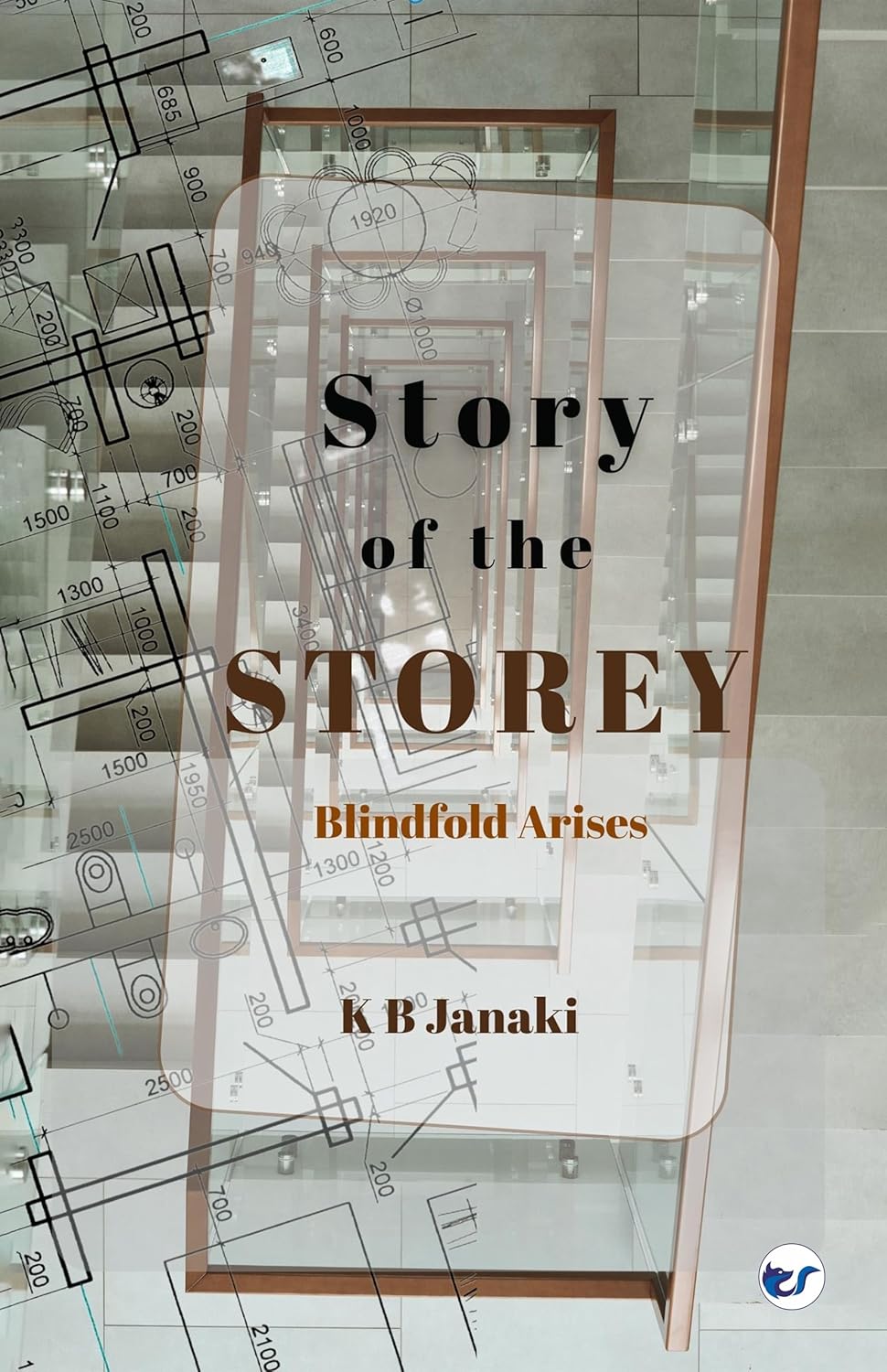
7. The title is intriguing: Story of the Storey. Can you explain the significance of the title,
and why you paired it with Blindfold Arises?
I wanted the title to echo both meaning and sound. Each floor of the building holds a different
story, so “storey” naturally fit. The alliteration in Story of the Storey adds rhythm. Blindfold
Arises reflects the unveiling of hidden truths. Just like a new building celebrates its
inauguration, the land in my story celebrates its awakening, the moment its secrets rise from
the blindfold of silence. A land blindfolds itself each and every time, awakens the spirit.
8. The novel seems to touch on themes like urban expansion, forgotten histories, and
societal denial. Was this your way of commenting on how cities evolve without
conscience?
Yes, absolutely. People often forget what existed before the city expanded. A place that once
stored rice or housed families might now carry skyscrapers, yet its essence remains. We build
without understanding what we’re erasing. My story questions that blind progress, how we
ignore history and still expect peace in spaces built over unresolved pasts.
9. You’ve chosen a slow-burn narrative style, rich in atmosphere and layered tension.
What challenges did you face in maintaining suspense throughout the book?
Maintaining suspense was challenging because it required patience and restraint. I couldn’t
reveal too much too soon, yet I had to keep readers curious. Every scene needed to hold a
quiet tension, sometimes through silence, sometimes through movement. I focused on the
pacing of thoughts and the rhythm of fear. The challenge was to make every ordinary moment
feel slightly “off.”
10. The story unfolds through multiple perspectives. How did this structure shape the
way readers connect with the mystery and the building itself?
The building becomes the central character, and each perspective offers a piece of its puzzle.
Through residents, investigators, and even the land’s memories, readers experience multiple
layers of truth. This structure mirrors the building itself, each floor tells a different version of
the same story. The fragmented narrative makes readers feel like detectives, piecing together
the invisible whole.
11. If Story of the Storey were to be adapted into a visual medium, how would you
envision it—a film, web series, or something else?
I would prefer a web series, each episode running about 25–35 minutes. Around 5 to 10
episodes would do justice to the slow-building suspense. The format allows for gradual
revelation, character depth, and lingering silence. It’s perfect for exploring the building’s
atmosphere, viewers can feel the claustrophobia and curiosity growing episode by episode.
12. Finally, what do you hope readers take away after finishing the book? Is there a
specific feeling or reflection you want them to sit with?
I want readers to close the book and still feel the echo of the building in their minds. Some
have told me it felt real, others said it was hauntingly beautiful. The best compliment is when
readers discuss and analyze it long after reading. I hope they realize that every space, like
every person, carries memories, and that forgetting comes at a price.