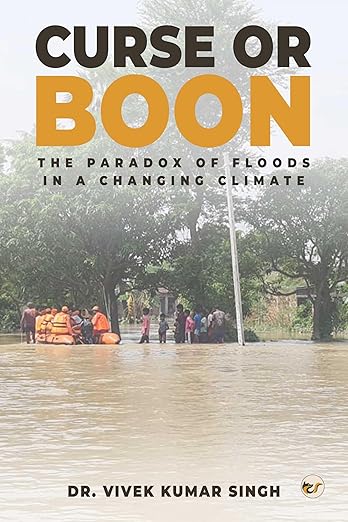
Curse or Boon: Every year, without fail, the waters come. They rise slowly at first creeping across fields, swallowing pathways, surrounding villages with a quiet inevitability that the people of Bihar have known for longer than written history can record. Then they surge. And with them comes everything: destruction and deposit, suffering and sustenance, loss and, quietly, renewal.
For most of the world watching from a distance, the story ends at destruction. Floods in Bihar make headlines as disasters. As tragedies. As failures of governance, of infrastructure, of nature itself. The images are always the same submerged homes, stranded families, ruined harvests, desperate faces.
But Vivek Kumar Singh asks the question nobody outside Bihar thinks to ask:
What if the full story is far more complicated than that?
A Book That Dares to See Differently
Curse or Boon: The Paradox of Flood is one of those rare books that doesn’t just add information to a conversation. It changes the conversation entirely.
Singh doesn’t arrive with simple answers or convenient conclusions. He arrives with something far more valuable a willingness to sit with complexity, to resist the comfortable narrative, and to look at one of India’s most enduring challenges through eyes that are both scholarly and deeply human.
What he finds is extraordinary.
Bihar’s relationship with floods isn’t a modern tragedy waiting for a modern solution. It is an ancient, layered, breathing relationship between a people and their rivers one that has been misread, oversimplified, and sometimes dangerously mismanaged because the full truth of it was never properly understood.
Curse or Boon is that understanding. Finally, completely, and beautifully told.
The Paradox That Changes Everything
Here is what Singh reveals at the heart of this book, and it will stay with you long after you’ve closed the final page:
The same water that destroys is also the water that feeds.
For millennia, Bihar’s extraordinary agricultural fertility the reason this land has sustained dense human civilization since ancient times has been inseparable from its floods. The rivers that overflow their banks each monsoon season carry with them something that no fertilizer factory has ever fully replicated: rich, life-giving silt that settles into the soil and transforms it into some of the most productive farmland on earth.
Traditional Bihar knew this. Farming calendars were built around flood cycles. Certain crops were cultivated specifically to thrive in post-flood conditions. Wetlands created by seasonal flooding became ecosystems of extraordinary richness—supporting fisheries, biodiversity, and water systems that sustained communities for months after the waters receded.
This is not romanticization. This is ecology. And Singh documents it with the precision of a scholar and the passion of someone who genuinely cares about getting the truth right.
The People at the Center
What makes Curse or Boon genuinely moving not just intellectually significant is how Singh handles the human dimension of this story.
The people of Bihar are not presented here as victims of geography or government failure, waiting passively for rescue. They are presented as they actually are: communities with centuries of accumulated wisdom about rivers, floods, soil, and survival. Communities that developed sophisticated indigenous knowledge systems precisely because they had to. Because the rivers were their reality, and reality has a way of teaching the willing student everything it knows.
There is a particular kind of intelligence that comes from living alongside something powerful and unpredictable for generations. It doesn’t always look like intelligence to outsiders. It looks like stubbornness, or poverty, or backwardness. But Singh understands and helps us understand that what looks like resignation to floods is often something much wiser: a negotiated understanding of forces too large to control, and too vital to simply fear.
When Solutions Become Problems
Curse or Boon most sobering contributions is its honest examination of what happens when well-intentioned flood management ignores this complexity.
Large embankments built to protect communities have sometimes trapped floodwaters instead of redirecting them intensifying damage in ways that the pre-embankment landscape never experienced. Agricultural systems designed without understanding traditional flood-dependent farming cycles have disrupted livelihoods that survived for centuries. Policies built on the assumption that floods are purely destructive have repeatedly failed to account for what is lost when the floods are prevented the silt, the wetlands, the ecological rhythms that made this land livable in the first place.
Singh makes this case not to paralyze action but to demand better action. Smarter action. Action that respects what local communities have always known and what outside experts have too often dismissed.
Culture, Memory, and the Soul of a Region
Beyond ecology and policy, Singh takes us somewhere even more intimate: into the cultural and spiritual life of a region shaped by water.
Floods in Bihar have influenced architecture, migration, community bonds, folk traditions, festivals, songs, and stories. Rivers here are not geographical features they are living presences, woven into the emotional and spiritual consciousness of the people who have lived alongside them across generations.
To read this book is to understand Bihar not just as a place on a map but as a civilization with a relationship to nature that is ancient, complex, and profoundly worth understanding.
Why Curse or Boon Matters Right Now
We live in an age of accelerating climate chaos. Extreme floods are becoming more frequent, more severe, and more disruptive across the entire world. And yet our frameworks for understanding them remain stubbornly simple floods are bad, prevention is good, disaster is disaster.
Curse or Boon offers a different framework. A more honest one. A more useful one.
It asks us to look beyond the immediate emergency and see the longer story. To listen to communities before imposing solutions upon them. To acknowledge that nature’s most challenging expressions are rarely as simple as they appear—and that wisdom, real wisdom, begins with the humility to admit that.
A Final Word
Vivek Kumar Singh has written something important here. Not just for Bihar. Not just for India. But for anyone trying to understand the complicated, beautiful, heartbreaking, and ultimately hopeful relationship between human beings and the natural world they inhabit.
This book Curse or Boon will change how you see floods. It will change how you see Bihar. And if you let it, it will change how you see the fine, fragile line between what we call a curse and what we call a blessing.
Because sometimes more often than we admit they are the same water.
Profound. Necessary. Deeply human.
A book Curse or Boon that doesn’t just deserve to be read it deserves to be heard.