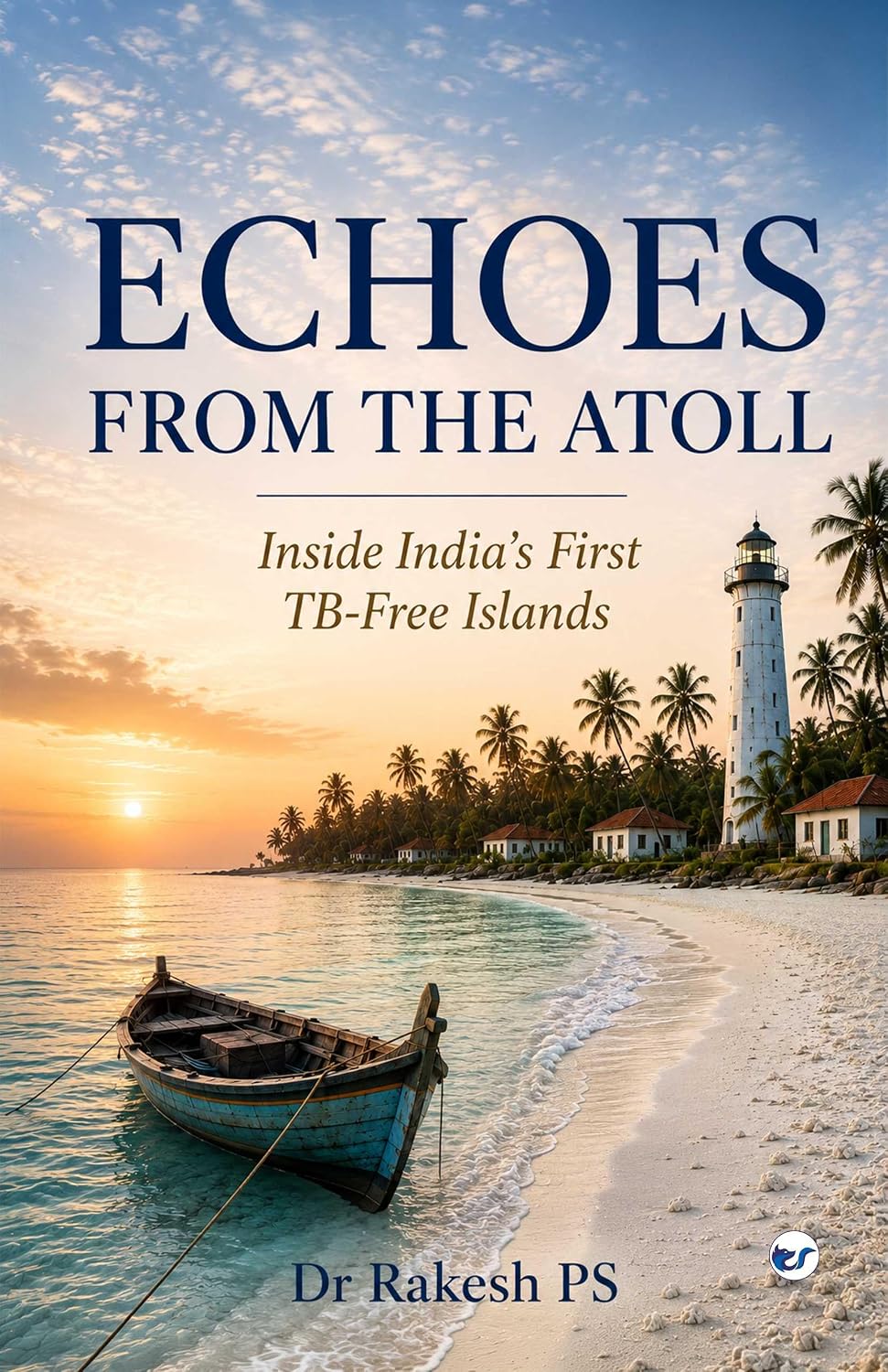
Echoes from the Atoll: Inside India’s First TB-Free Islands by Rakesh PS is a deeply engaging memoir that brings together public health, travel, human resilience, and the fragile beauty of Lakshadweep. Rather than presenting tuberculosis elimination as a collection of statistics and medical achievements, the author takes readers into the heart of the islands and introduces them to the people, communities, landscapes, and everyday realities behind India’s first TB-free geography.
What makes the book particularly compelling is its ability to transform a public health achievement into a deeply human story. Through fourteen journeys across the islands, Rakesh PS captures experiences that go far beyond the boundaries of his professional work.
More Than a Public Health Story
At first glance, the book may appear to be about tuberculosis elimination, but its scope is much broader. The author shows that successful public health interventions are not created by healthcare systems alone. They depend on trust, community participation, local understanding, perseverance, and the willingness of ordinary people to work toward a shared goal.
The TB-free achievement becomes a reflection of collective strength. Islanders, healthcare workers, communities, and public health professionals all become part of a larger story—one where cooperation and human connection are as important as medical intervention.
A Journey Through Lakshadweep
One of the book’s most appealing elements is its portrayal of Lakshadweep. The author takes readers aboard crowded boats, across moonlit beaches, through village tea shops, and into quiet island homes. These descriptions create a strong sense of place without turning the memoir into a conventional travelogue.
The islands emerge as more than beautiful tourist destinations. They are living communities with their own rhythms, memories, traditions, relationships, and vulnerabilities. The sea is not merely a backdrop; it is an essential part of island life, influencing movement, work, communication, and even the way people experience time.
The Human Stories Behind the Mission
The strength of Echoes from the Atoll lies in its human perspective. Public health campaigns can often appear distant when viewed through reports, targets, and statistics. Rakesh PS brings those numbers back to life by focusing on people and their experiences.
The memoir reminds readers that behind every diagnosis is an individual, behind every treatment is a family, and behind every successful health programme is a community. This human-centered approach makes the book accessible even to readers who may not have a background in medicine or public health.
A Powerful Message About Community
One of the most important themes running through the book is collective responsibility. The achievement of making Lakshadweep TB-free demonstrates how meaningful change can happen when communities participate actively in a shared mission.
The book subtly emphasizes that healthcare is not only about hospitals, medicines, and doctors. It is also about awareness, empathy, trust, communication, and understanding the social realities in which people live.
This perspective makes the memoir especially valuable for readers interested in public health, social development, and community-based interventions.
The Fragile Beauty of the Islands
Alongside the TB-free journey, the author also explores the changing face of Lakshadweep. Tourism, economic development, and increasing external influence are gradually transforming the islands.
This section of the memoir adds another layer of emotional depth. The author does not simply celebrate progress; he also asks readers to consider what might be lost in the process. As development accelerates, traditional ways of life, community bonds, ecological balance, and cultural memories may become increasingly vulnerable.
The book therefore raises an important question: Can development move forward without erasing the identity of the places it seeks to transform?
A Quiet Reflection on Modernity
Rather than aggressively criticizing modernization, Rakesh PS approaches the subject with warmth and restraint. His concern comes across as affection for a place and its people rather than resistance to change.
This balanced perspective makes the discussion particularly effective. Progress is necessary, but the book encourages readers to consider whether progress should also include protecting memories, ecosystems, traditions, and ways of life that cannot easily be restored once they disappear.
Writing That Feels Personal and Authentic
The author’s writing style is one of the book’s strongest features. It is reflective, descriptive, and personal without becoming overly sentimental. The narrative moves naturally between professional experiences, island landscapes, community encounters, and broader reflections on health and society.
The result is a memoir that feels intimate and sincere. Readers are not simply told what happened; they are invited to experience the atmosphere of the islands and understand why these journeys remained meaningful to the author.
A Book About Memory and Belonging
At its deepest level, Echoes from the Atoll is a book about memory. It explores what people remember, what places hold within them, and how rapidly changing societies can sometimes leave important stories behind.
The title itself captures this beautifully. The “echoes” are not only memories of the author’s journeys but also the voices, experiences, struggles, and traditions of island communities. They remind readers that some of the most important stories are often found far from crowded cities and mainstream narratives.
Why This Book Deserves to Be Read
Echoes from the Atoll will appeal to a wide range of readers. Those interested in public health will appreciate its insight into community-based TB elimination. Travel and nature enthusiasts will enjoy its evocative portrayal of Lakshadweep. Readers interested in social issues will find its reflections on development and cultural change thought-provoking.
Most importantly, the book encourages readers to look beyond headlines and achievements and understand the human stories behind them.
Final Verdict
Echoes from the Atoll: Inside India’s First TB-Free Islands is a thoughtful and beautifully observed memoir that brings together medicine, travel, community, ecology, and memory. Rakesh PS succeeds in showing that the story of tuberculosis elimination is ultimately a story about people—their trust, resilience, cooperation, and determination.
At the same time, the book serves as a gentle reminder that beautiful places are more than landscapes. They are homes, memories, communities, and living cultures. As Lakshadweep changes, Echoes from the Atoll becomes an important record of a moment when public health success and island life came together in a remarkable story.