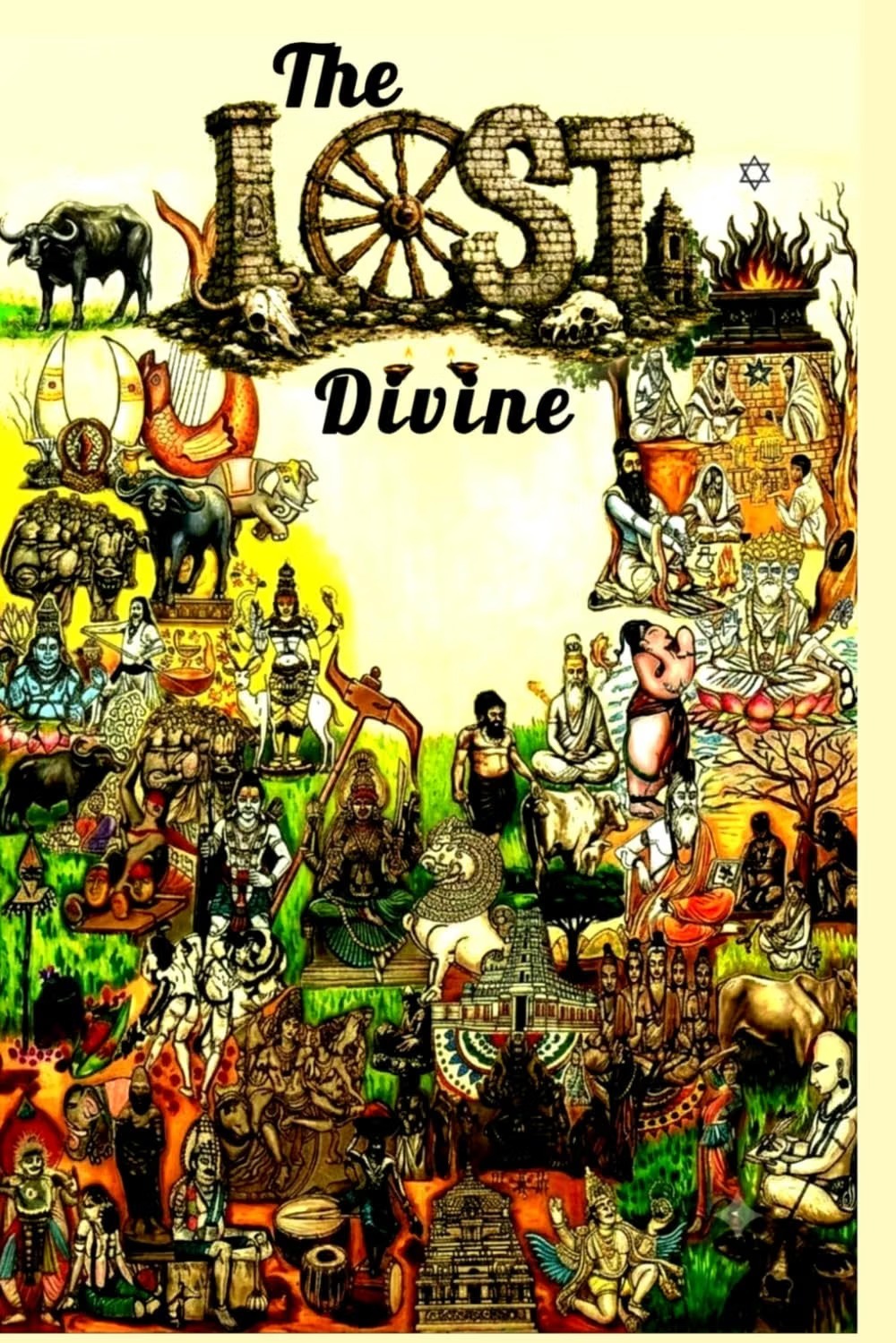
The Lost Divine, written By Brikut A , is an intriguing and ambitious exploration of India’s forgotten, transformed, and lesser-known religious traditions. Rather than presenting mythology simply as a collection of familiar divine stories, the book attempts to look beneath established narratives and investigate the older layers of belief that existed before and alongside the traditions that later became dominant.
The book’s central idea is both fascinating and challenging: religious traditions evolve over time. Stories change, deities acquire new identities, rituals are adapted, and different cultural communities influence one another. Through this perspective, The Lost Divine encourages readers to look at Indian religious history not as a fixed body of beliefs but as a constantly evolving cultural landscape.
Exploring the World of Pre-Vedic Deities
One of the most interesting aspects of the book is its focus on Naattaar Deivams, or indigenous and folk deities associated with regional traditions. These figures often occupy an important place in local communities but may receive far less attention in mainstream discussions of Indian mythology.
The book introduces readers to a remarkably wide range of divine and semi-divine figures, including Bodrai, Vanapechi, Kamandi, Thavvai, Pidari, Ilakkumi, Kalaimagal, Murugu, Seyon, Kandan, Kaathaayi, Vendhan, Mayon, Neeli, Masani, Mariamma, Aravan, Karuppu, Sudalai, Muneeswaran, and many others.
This extensive list is one of the book’s greatest strengths. It demonstrates how diverse India’s religious traditions have been and how deeply spirituality has been connected with local landscapes, occupations, communities, fears, hopes, and cultural memories.
Folklore as a Window into the Past
The inclusion of folklore makes The Lost Divine particularly appealing. Folk stories are often preserved through oral traditions rather than formal written texts, and they can provide valuable insight into how ordinary communities understood the world around them.
The book acknowledges the role of folklore narrators alongside historical research. This combination creates an interesting foundation for exploring traditions that may not always appear in conventional religious literature.
Stories passed down through generations can reveal how communities interpreted nature, fertility, disease, death, protection, warfare, prosperity, and other aspects of life. In this sense, the book is not simply discussing gods and goddesses; it is exploring the cultural memories and social realities surrounding them.
Questioning Familiar Narratives
Another compelling feature of The Lost Divine is its willingness to ask uncomfortable questions. The author openly acknowledges that the research presented in the book affected their own religious beliefs. This personal dimension gives the project a sense of intellectual curiosity.
Importantly, the book’s stated intention is not to offend any religion or community but to encourage readers to investigate historical and cultural changes. This distinction is important because discussions surrounding mythology and religious identity can easily become emotionally charged.
The book therefore works best when approached with an open and questioning mind. Readers do not necessarily have to accept every interpretation presented; instead, they can consider the material as an invitation to investigate, compare sources, and think about how traditions develop.
The Synthesis of Cultures and Traditions
A major theme running through the book is the interaction between different cultural groups and religious traditions. The author examines the idea that indigenous beliefs underwent significant changes through cultural synthesis.
This is particularly interesting because Indian religious history is extraordinarily diverse. Local traditions did not exist in isolation. Over centuries, communities interacted, exchanged ideas, adopted rituals, and connected local deities with broader religious traditions.
The book encourages readers to consider how such processes may have changed the identities and stories associated with various deities. This makes The Lost Divine relevant not only to readers interested in religion but also to those fascinated by anthropology, folklore, history, sociology, and cultural studies.
A Remarkably Diverse Collection of Deities
The sheer variety of figures discussed gives the book an exploratory quality. Readers encounter deities associated with different regions, traditions, communities, and symbolic roles.
Figures such as Mariamma, Pidari, Karuppu, Sudalai, Muneeswaran, Masani, Aravan, and Neeli evoke very different cultural associations. Elsewhere, names such as Murugu, Seyon, Mayon, Kandan, and other figures demonstrate the complex ways in which ancient and regional traditions can overlap and transform.
The inclusion of lesser-known figures is particularly valuable because it expands the reader’s understanding beyond the familiar pantheon encountered in popular retellings of Indian mythology.
A Book for Curious Readers
The Lost Divine is unlikely to appeal to readers looking for a conventional mythology book filled with straightforward devotional stories. Instead, it is better suited to readers who enjoy questioning established narratives and exploring alternative historical and cultural perspectives.
Its strongest appeal lies in curiosity. The book asks readers to pause and wonder: Where did these traditions originate? How did their stories change? Why did some deities become widely recognized while others remained primarily local? What happens to oral traditions when cultural systems transform?
These questions give the book intellectual value beyond its individual stories.
An Ambitious and Thought-Provoking Work
The subject covered by The Lost Divine is enormous, and attempting to bring together historians, folklore, indigenous traditions, and religious evolution is undoubtedly ambitious. At times, readers may find the subject matter dense or unfamiliar, particularly when encountering names and traditions they have never previously studied.
However, this complexity is also part of the book’s appeal. It encourages readers to slow down, investigate unfamiliar concepts, and appreciate the extraordinary diversity of India’s cultural heritage.
The book would be especially rewarding for readers who enjoy approaching mythology from historical, anthropological, or comparative perspectives rather than purely devotional ones.
Final Verdict
The Lost Divine is an unconventional and intellectually stimulating exploration of India’s forgotten and transformed religious traditions. Through its discussion of Pre-Vedic and folk deities, oral folklore, historical research, and cultural synthesis, the book invites readers to look beyond familiar religious narratives and explore the layers of history hidden beneath them.
What makes the book particularly interesting is its spirit of inquiry. It does not simply ask readers to believe; it encourages them to investigate. It reminds us that mythology is also a record of cultural memory, and that the stories communities preserve can reveal much about their history, identity, and worldview.