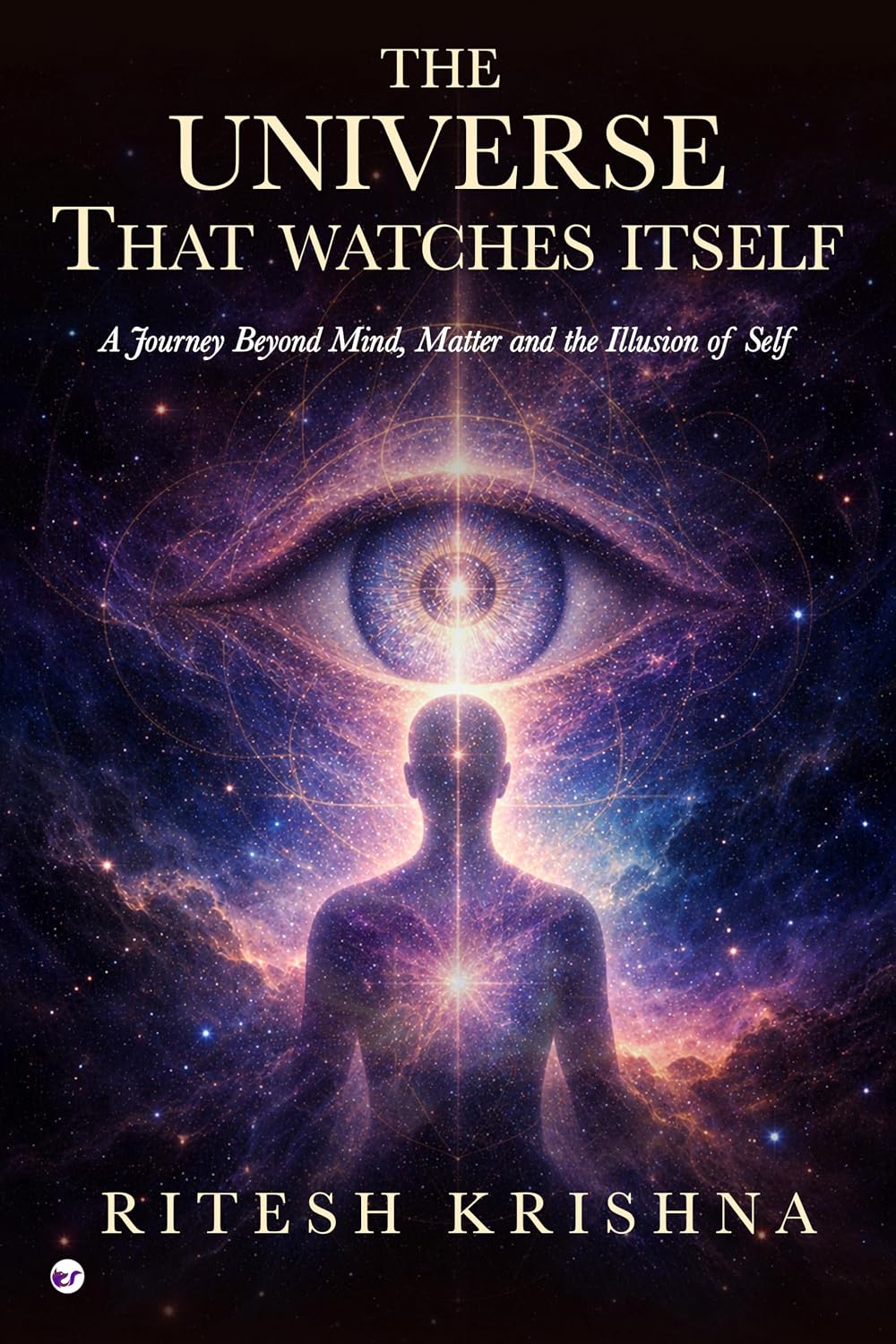
Some books answer questions, while others inspire readers to ask better ones. THE UNIVERSE THAT WATCHES ITSELF: A Journey Beyond Mind, Matter, and the Illusion of Self by Ritesh Krishna belongs to the latter category. Blending philosophy, modern science, and the study of consciousness, this thought-provoking work invites readers on an intellectual and spiritual journey that challenges long-held assumptions about reality, identity, and existence itself.
Rather than presenting rigid conclusions, the author encourages curiosity and self-inquiry, making the book less of a lecture and more of an open conversation. It is a profound exploration for readers who enjoy questioning the nature of the universe and humanity’s place within it.
Where Science Meets Consciousness
One of the book’s greatest strengths is its ability to bridge scientific understanding with philosophical reflection. Beginning with the origins of the universe, Ritesh Krishna explores concepts such as quantum fields, geometry, resonance, energy, and cosmic structures in a way that naturally leads into deeper discussions about awareness and consciousness.
Instead of treating science and philosophy as opposing viewpoints, the author presents them as complementary approaches to understanding reality. This balanced perspective creates a refreshing reading experience that appeals to both analytically minded readers and those interested in metaphysical exploration.
The transition between scientific principles and personal awareness is handled with remarkable clarity, allowing even complex ideas to feel approachable and engaging.
Questioning the Nature of Reality
Throughout the book, readers are invited to reconsider some of life’s most fundamental assumptions. Is reality truly composed of solid objects, or is everything better understood as dynamic fields of energy? Is consciousness merely a product of brain activity, or does it extend beyond the limits of the human mind?
Rather than offering definitive answers, the author encourages thoughtful reflection. This approach respects the reader’s intelligence and creates space for personal interpretation instead of imposing a single worldview.
The book’s greatest achievement lies in making readers comfortable with uncertainty. Instead of fearing unanswered questions, readers begin to appreciate the value of inquiry itself.
The Illusion of the Separate Self
A central theme of THE UNIVERSE THAT WATCHES ITSELF is the concept of identity. The author carefully examines the idea of the individual self, questioning whether our sense of separation from the universe is genuine or simply a mental construct.
This exploration is both philosophical and deeply personal. By encouraging readers to observe their own thoughts, emotions, and perceptions, the book gradually shifts attention away from fixed identities toward a broader understanding of awareness.
These reflections are presented with sensitivity and depth, making the material accessible without oversimplifying complex philosophical ideas. Readers familiar with Eastern philosophy, non-duality, or contemplative traditions will find many familiar themes presented through a fresh and contemporary perspective.
A Journey Through Conscious Awareness
Unlike many books that focus solely on abstract theories, this work consistently invites readers to connect ideas with direct experience. Rather than asking readers to accept new beliefs, Ritesh Krishna encourages them to examine their own consciousness with openness and honesty.
The discussions surrounding free will, suffering, perception, and awareness become particularly compelling because they are framed as questions for personal exploration rather than philosophical debates to be won.
This experiential approach transforms the book into something more meaningful than an intellectual exercise. It becomes an opportunity for genuine self-reflection.
Writing That Encourages Reflection
One of the book’s most admirable qualities is its thoughtful and measured writing style. The language is elegant without becoming overly academic, allowing sophisticated concepts to remain understandable for a broad audience.
The author avoids sensational claims and exaggerated spiritual promises. Instead, every chapter unfolds patiently, encouraging readers to pause, reflect, and absorb each idea before moving forward.
This calm and contemplative tone perfectly complements the subject matter, making the reading experience both intellectually stimulating and emotionally grounding.
Who Should Read This Book?
This book is particularly suited for readers interested in philosophy, psychology, quantum physics, pholosophy , consciousness studies, and personal growth. Those who enjoy authors exploring the intersection of science and human awareness will find this work especially rewarding.
At the same time, readers should approach the book with patience and an open mind. It is not a fast-paced narrative or a conventional self-help guide. Instead, it is a reflective journey designed to be contemplated rather than rushed.
Final Verdict
THE UNIVERSE THAT WATCHES ITSELF: A Journey Beyond Mind, Matter, and the Illusion of Self is an intellectually rich and deeply contemplative work that successfully bridges science, philosophy, and consciousness into a unified exploration of reality. Ritesh Krishna challenges readers to look beyond surface appearances and examine the profound relationship between the observer and the universe itself.
Insightful, thought-provoking, and elegantly written, this book does not seek to provide easy answers. Instead, it offers something far more valuable—the opportunity to question, reflect, and experience reality from an entirely new perspective. For readers willing to embrace uncertainty and engage in meaningful self-inquiry, this book is both enlightening and transformative.