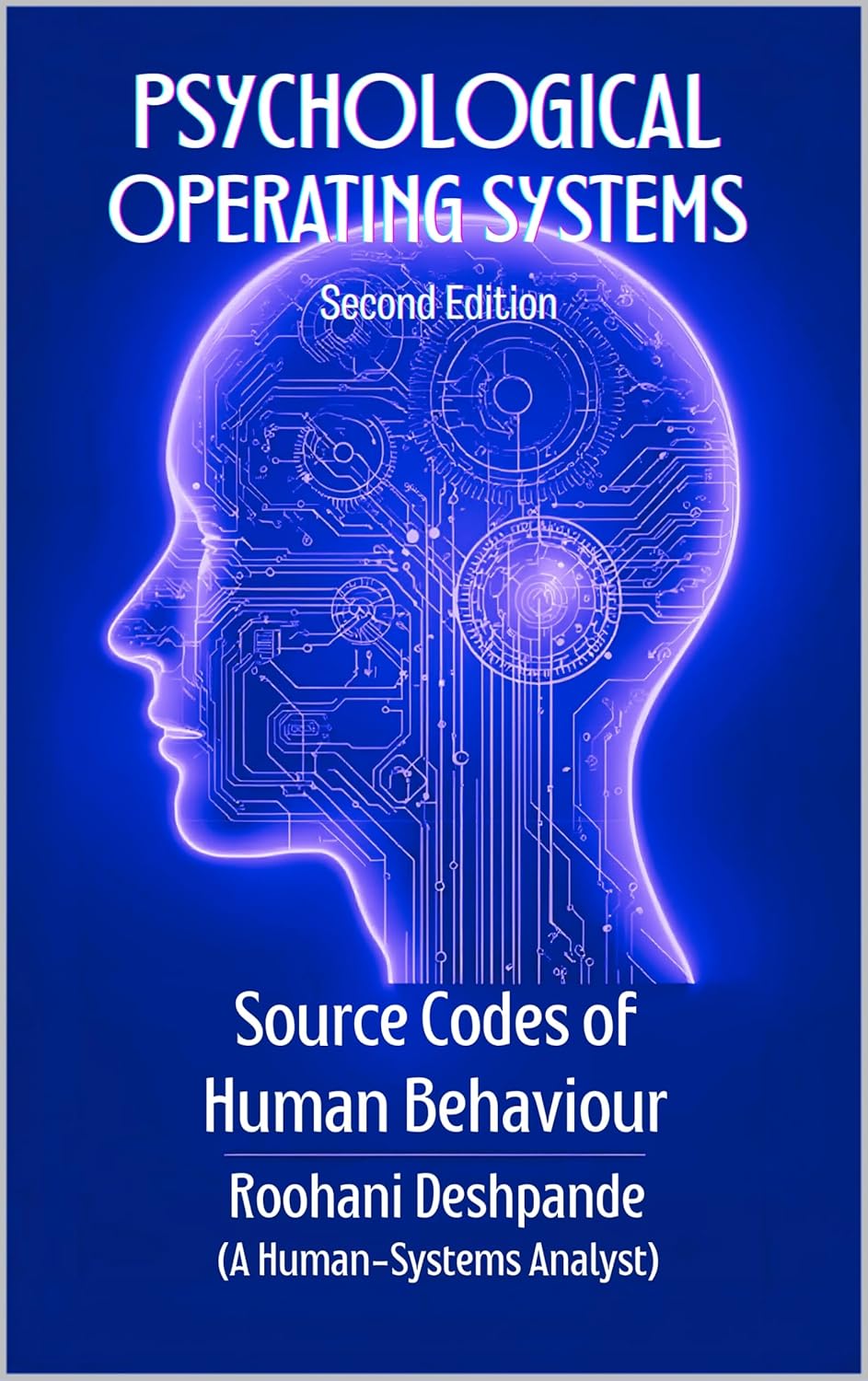
Psychological Operating Systems: Source Codes of Human Behaviour: There are books that describe human behaviour, and then there are books that reframe how you think about it entirely. Roohani Deshpande‘s Psychological Operating Systems: Source Codes of Human Behaviour firmly belongs to the second category. It is one of those rare reads that makes you pause mid-chapter, look up, and see the people around you differently — not with judgment, but with a clarity you did not have before.
The Central Premise: We Are Not All Running the Same System
The central premise is deceptively simple: what if human beings do not all run on the same psychological “operating system”? What if the friction, misunderstandings, and recurring conflicts in our relationships, workplaces, and societies are not the result of bad intentions or moral failings, but of fundamental incompatibilities between the way different minds are wired to process and respond to the world?
Deshpande introduces this idea with the precision of a systems engineer and the curiosity of a psychologist. The technical metaphor — source code, operating systems, algorithms, system errors — is not mere gimmick. It is a genuinely useful framework that allows the author to describe complex psychological dynamics in language that is concrete, logical, and free from the vagueness that often plagues social science writing. For readers who have always found psychology too abstract or too reliant on intuitive leaps, this book is something of a revelation.
Two Operating Systems, One World
At the heart of the model are two contrasting operating systems. The first is described as the dominant societal OS — one built around social harmony, unspoken rules, and the constant management of others’ perceptions. This is the system most institutions, cultures, and social environments are implicitly designed to reward. The second is an OS that prioritises factual accuracy, direct communication, and internal consistency over social performance. Deshpande explores how individuals running this second system often find themselves in a world whose unwritten rules were never explained to them, navigating environments that feel, at times, like a foreign country with no phrase book.
Neither System Is Wrong
What makes this framework particularly compelling is that it does not pathologise either system. Rather than framing one as correct and the other as deficient, Deshpande presents both as legitimate ways of processing reality — each with its own strengths, blind spots, and social consequences. The concept of the “social translation algorithm” is especially insightful: the idea that some individuals must consciously translate their authentic internal responses into socially acceptable outputs, a cognitive process that is exhausting precisely because it is never automatic.
From the Personal to the Societal
The book’s scope is also admirably ambitious. Deshpande does not limit the analysis to individual interaction. The framework scales upward — from personal relationships to institutional behaviour, from workplace dynamics to broad cultural patterns. The argument that collective social systems are themselves expressions of a dominant OS, and that this shapes everything from organisational hierarchies to political discourse, is thought-provoking and largely convincing. It invites readers to look at societal structures not as neutral or inevitable, but as products of particular cognitive preferences that have been normalised over time.
Universal Relevance, Not Just a Niche Read
While the book is clearly informed by neurodiverse perspectives, and will resonate deeply with readers who identify as neurodivergent, it would be a mistake to categorise it as a niche text for a specific audience. The questions it raises — about authenticity, communication, the hidden architecture of social rules — are universal. Anyone who has ever felt like an outsider in a room full of people following rules they could not quite articulate will find something valuable here. And those who have never experienced that particular dissonance may find it opens a genuine window into an experience they had not previously understood.
Precise, Purposeful Writing
The writing is measured and precise throughout. Deshpande resists the temptation to oversimplify, while also never losing the reader in unnecessary complexity. The use of technical analogies is consistent and purposeful, grounding abstract psychological concepts in tangible, reproducible logic. It reads, appropriately enough, like a manual — one that is genuinely useful rather than merely instructional.
If there is a critique to be offered, it is that some readers accustomed to more narrative-driven psychology writing may find the systemic approach initially unfamiliar. But that unfamiliarity is precisely the point. Deshpande is deliberately offering a different lens, and the willingness to adjust one’s reading expectations is rewarded generously.
Verdict: Essential Reading
Psychological Operating Systems is a quietly important book. It gives analytical minds the explicit framework they have long needed, and gives everyone else a more honest map of the invisible systems shaping every human interaction. Essential reading.