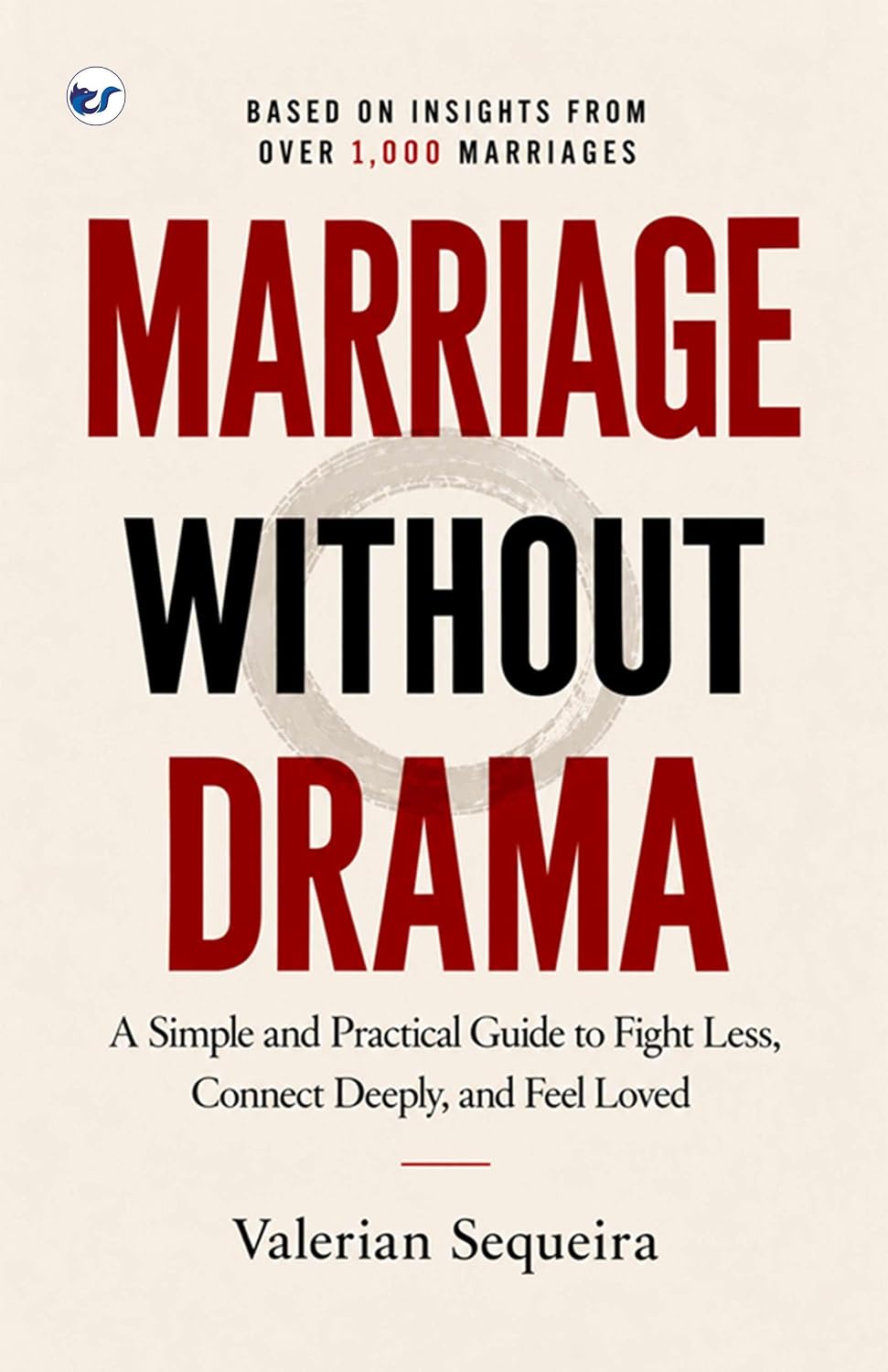
Marriage often begins with love, hope, and the promise of building a beautiful life together. Two people enter the relationship believing that their love, understanding, and commitment will help them overcome any challenge. Yet, as time passes, even loving couples can find themselves trapped in arguments, emotional distance, misunderstandings, and silence. How do two people who genuinely love each other end up feeling like strangers? In Marriage Without Drama, Valerian Sequeira explores this question and offers a thought-provoking perspective on the hidden patterns that can gradually damage a marriage.
Drawing on insights from more than 1,000 marriages and fifteen years of experience working with couples, the author examines why relationship conflicts often persist despite the best intentions of both partners. Rather than blaming incompatibility or a lack of love, the book encourages readers to look deeper into their own behaviour, emotional reactions, and expectations.
The Hidden Cause of Marital Conflicts
One of the central ideas of Marriage Without Drama is that many relationship problems are not simply caused by two people being wrong for each other. Instead, conflicts can develop through recurring behavioural patterns that neither partner fully recognises.
When disagreements arise, both individuals may feel misunderstood, unappreciated, or unfairly treated. Each begins to focus on what the other person has done wrong, often overlooking their own contribution to the situation. As these reactions repeat, small disagreements can grow into larger emotional barriers.
The book introduces the victim mindset as an important factor in this cycle. When both partners believe they are the ones being hurt, neither may be willing to examine their own behaviour honestly. This creates a frustrating situation in which both people want the relationship to improve, yet their responses continue to deepen the conflict.
This perspective encourages readers to move beyond assigning blame and begin recognising the patterns that influence their relationships.
Self-Awareness: The Beginning of Change
A particularly meaningful message in the book is the importance of understanding oneself before attempting to change a partner. It is natural to notice a spouse’s shortcomings, especially during moments of disappointment or anger. However, lasting improvement requires the willingness to examine one’s own reactions, assumptions, and emotional habits.
Instead of asking only why a partner behaves a certain way, readers are encouraged to consider how they respond to difficult situations and whether those responses contribute to repeated disagreements.
This approach makes the book’s message relevant beyond marriage. Self-awareness, accountability, and emotional maturity are essential in every close relationship. By recognising unhealthy patterns, couples can begin replacing defensive reactions with more thoughtful responses.
Understanding Relationship Psychology
The book draws on concepts such as the Drama Triangle, Parent and Child Energy, and John Gottman’s Four Horsemen to explain relationship dynamics.
These frameworks provide readers with ways to understand recurring conflicts, emotional reactions, and communication patterns. They encourage couples to look beyond the immediate argument and consider the deeper behaviours that may be sustaining it.
Rather than viewing every disagreement as an isolated problem, readers are invited to recognise the larger cycle behind repeated arguments. This shift in perspective can help couples approach challenges with greater awareness and a willingness to take responsibility for their actions.
The emphasis is not simply on finding the right words during an argument, but on understanding why the same conflicts keep returning.
A Practical Perspective on Marriage and Healing
What makes Marriage Without Drama particularly relevant is its focus on the realities of long-term relationships. Marriage is not sustained by love alone; it also requires patience, respect, understanding, and the ability to navigate difficult emotions.
The book speaks to couples preparing for marriage as well as those who have spent years together and are struggling with distance or recurring disagreements. It also carries an important message for newlyweds: preparing for a successful marriage involves more than planning a wedding or imagining a happy future. It means learning to recognise personal limitations and understanding how two different individuals can build a life together.
For couples experiencing difficulties, the book offers an opportunity to reflect on their relationship from a different perspective. Although reading alone cannot resolve every marital problem, greater awareness can be a valuable starting point for meaningful conversations and positive change.
Final Thoughts
Marriage Without Drama by Valerian Sequeira offers a thoughtful exploration of the behavioural patterns that can influence marital happiness. Its central message is both challenging and encouraging: improving a relationship begins not only with understanding a partner, but also with developing the courage to understand oneself.
By focusing on self-awareness, relationship psychology, and recurring conflict patterns, the book encourages couples to approach marriage with greater maturity and empathy. It reminds readers that a healthy relationship is not one without disagreements, but one in which both partners are willing to learn, grow, and work through challenges together.