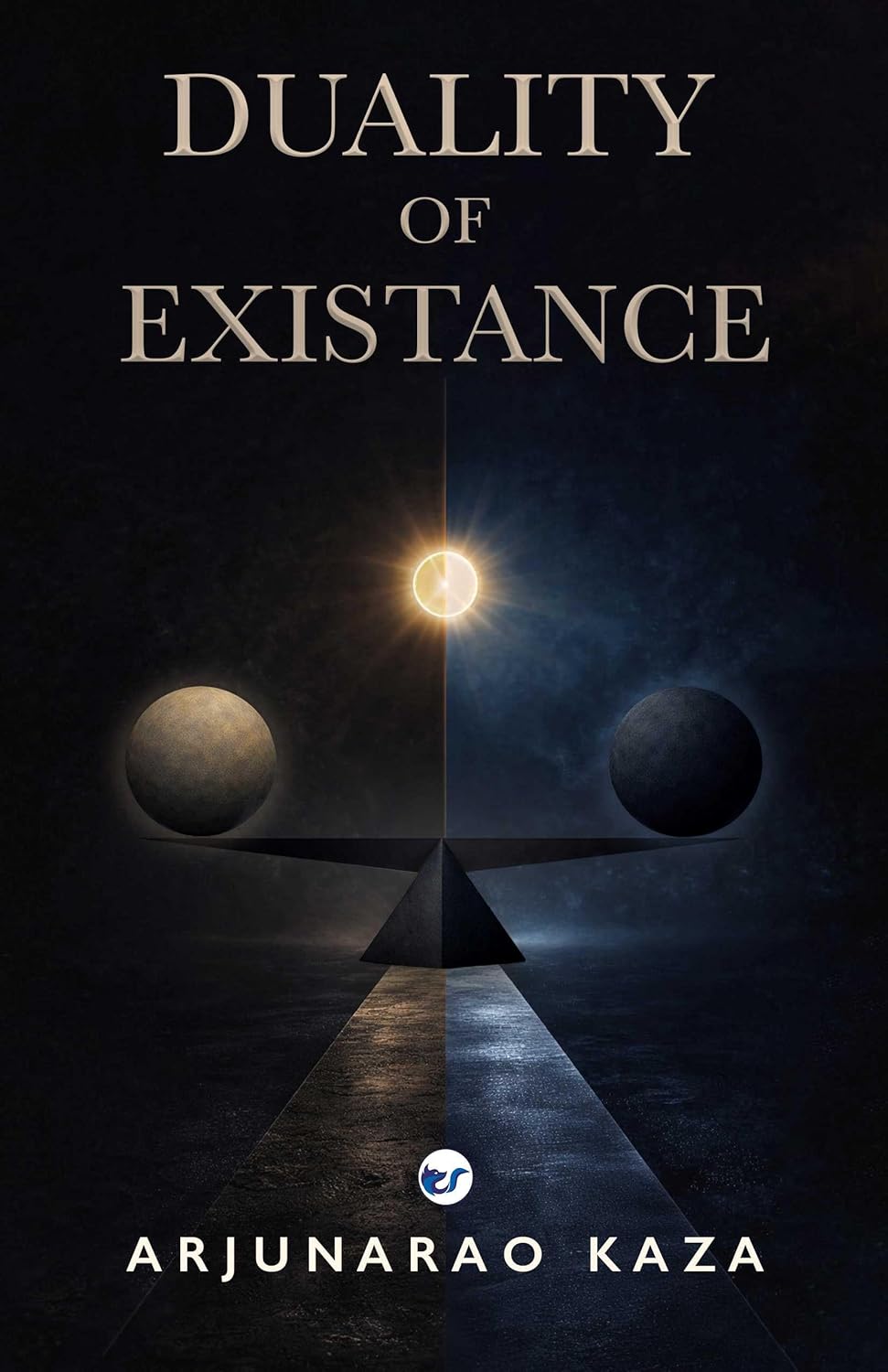
Duality of Existence by Arjunarao Kaza
A Bold Departure from Comfort Literature
In a literary landscape saturated with self-help formulas and feel-good spirituality, Duality of Existence by Arjunarao Kaza emerges as a strikingly different voice. It does not aim to soothe, inspire, or motivate in the conventional sense. Instead, it challenges, questions, and unsettles. This is a book that deliberately avoids offering comfort, choosing instead to confront readers with the raw and often uncomfortable nature of reality.
Kaza’s work is deeply philosophical, rooted in inquiry rather than instruction. From the very beginning, the book signals its intent-to move beyond surface-level understanding and explore the foundational contradictions that shape existence itself.
The Core Idea: Existence as Duality
At the heart of the book lies a powerful and thought-provoking premise: existence is born from the interaction of two eternal and opposing forces. One is driven by dynamic, expansive desire, while the other is characterized by restraint, stillness, and minimal impulse. These forces are not in conflict in the traditional sense-they are interdependent, inseparable, and essential to the functioning of reality.
Through this lens, Kaza redefines how we perceive the universe. Rather than viewing life as a linear or harmonious progression, he presents it as a constant interplay of tension and balance. This duality is not limited to cosmic or abstract dimensions; it is embedded in every aspect of life, from biological processes to human emotions and social systems.
Rethinking Morality and Human Perception
One of the most compelling aspects of Duality of Existence is its critique of moral absolutism. The book firmly rejects the idea that good and bad exist as independent, opposing absolutes. Instead, it argues that they are intrinsically linked-two sides of the same reality.
Kaza suggests that the human tendency to pursue absolute goodness or purity often leads to unintended consequences. In striving to eliminate what is perceived as “bad,” individuals and societies may fall into patterns of denial, hypocrisy, and moral distortion. This perspective is both provocative and liberating, as it encourages readers to move beyond rigid moral frameworks and embrace a more nuanced understanding of behavior and ethics.
A Critical Look at Spirituality and Religion
The book does not shy away from examining spirituality and religion, particularly their idealistic and ritualistic dimensions. Kaza challenges the notion that spiritual growth lies in transcending or escaping life’s contradictions. Instead, he argues that such attempts often weaken awareness rather than strengthen it.
By questioning commonly accepted beliefs, Duality of Existence invites readers to reconsider their own spiritual practices. It suggests that true understanding does not come from avoiding conflict or discomfort but from engaging with it consciously. This perspective positions the book as a counterpoint to mainstream spiritual narratives that emphasize positivity and perfection.
The Human Condition: Living Within Tension
A recurring theme throughout the book is the idea that human maturity is defined not by resolution but by recognition. Life, according to Kaza, is inherently unresolved. Conflict, contradiction, and tension are not problems to be solved-they are conditions to be understood.
This insight is particularly relevant in the context of modern life, where there is often a strong emphasis on clarity, certainty, and control. Duality of Existence challenges this mindset, proposing that true awareness comes from accepting ambiguity and responding to it with responsibility and restraint.
Writing Style: Reflective and Intellectually Engaging
Kaza’s writing is deliberate, reflective, and deeply introspective. It demands attention and engagement from the reader, making it a book that cannot be rushed. Each chapter builds upon the central idea of duality, expanding it into different areas of thought and experience.
The language is accessible yet layered, allowing readers from diverse backgrounds to engage with the content while still offering depth for those inclined toward philosophical exploration. Rather than relying on anecdotes or storytelling, the book focuses on reasoning and insight, creating a reading experience that is both challenging and rewarding.
Not for Everyone-and That’s Its Strength
It is important to note that Duality of Existence is not a book for everyone. Readers looking for quick takeaways, motivational guidance, or emotional reassurance may find it demanding or even unsettling. However, this is precisely what gives the book its strength.
By refusing to conform to popular expectations, Kaza creates a space for genuine inquiry. The book does not attempt to please or persuade; it simply presents a perspective and allows readers to engage with it on their own terms. This honesty makes it a valuable contribution to contemporary philosophical literature.
A Thought-Provoking Contribution to Modern Philosophy
In its essence, Duality of Existence is an exploration of reality in its most unfiltered form. It does not offer solutions to life’s contradictions, nor does it attempt to resolve them. Instead, it seeks to clarify their nature and significance.
For readers willing to engage deeply, the book offers a transformative experience-not by changing what they think, but by reshaping how they think. It encourages a shift from seeking answers to embracing awareness, from avoiding conflict to understanding it.
Final Verdict
Duality of Existence is a bold, introspective, and intellectually rigorous work that challenges conventional perspectives on morality, spirituality, and reality itself. It is a book that lingers in the mind, prompting reflection long after it has been read.
For those who are ready to move beyond comfort and engage with the complexity of existence, this book offers a rare and valuable journey-one that is as demanding as it is enlightening.