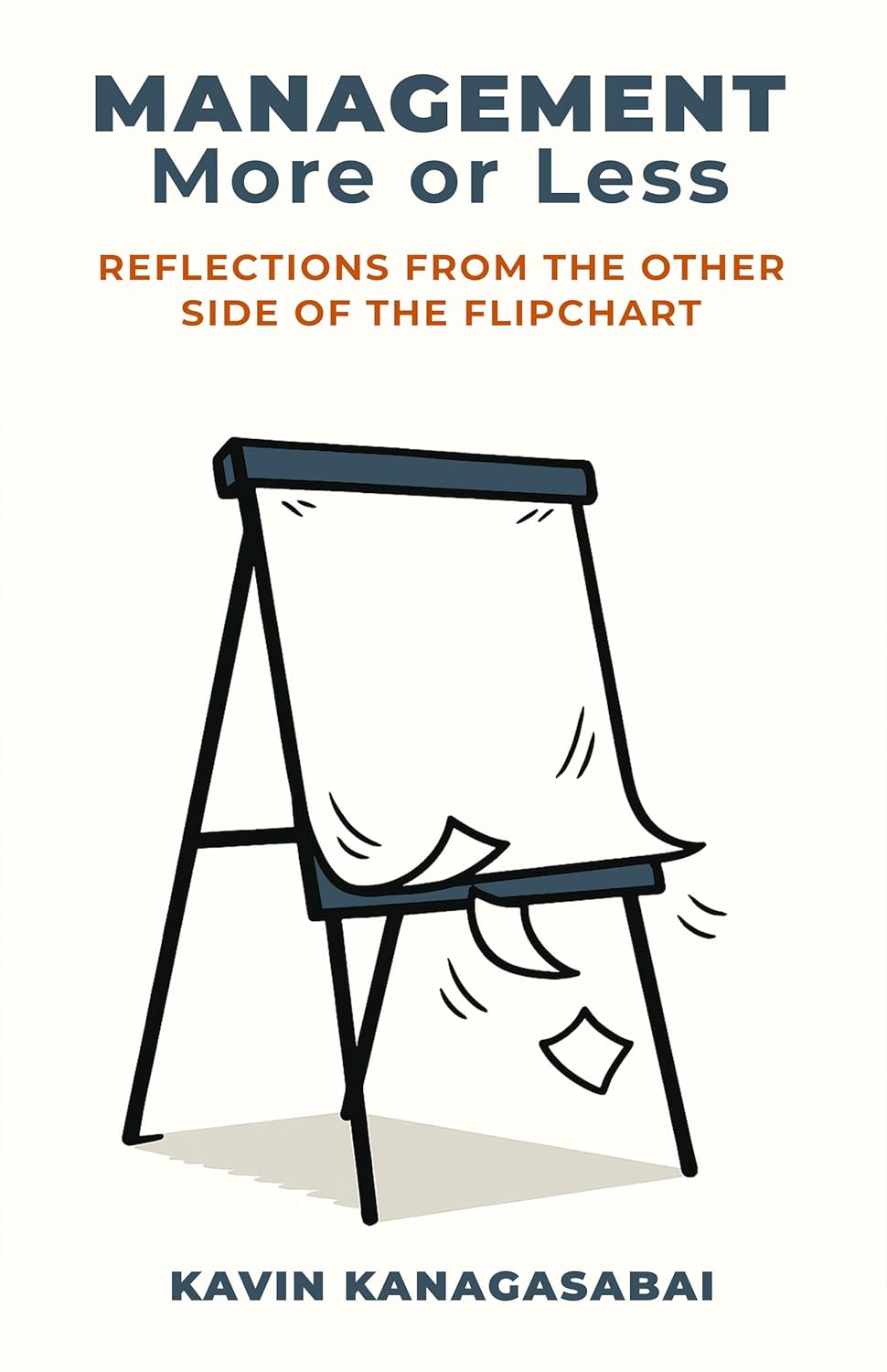
In an era filled with books that promise instant management fixes, step-by-step formulas, or guaranteed success through five rules and seven habits, Management, More or Less: Reflections from the Other Side of the Flipchart offers something refreshingly different.
It is not a manual. It is a mirror.
Kavin Kanagasabai has spent years observing teams, leaders, and organisations — not from the boardroom podium where everything is glossy and well-lit, but from a quieter space where candid conversations happen. The result is a book that looks at what actually happens when people try to get work done together.
The tone of the essays is gentle, curious and deeply familiar. Kanagasabai does not scold or lecture. Instead, he watches patterns unfold, explains why certain situations feel stuck, and shows how everyday behaviour — far removed from big theories — shapes progress.
Patterns, Habits, and the Blind Spots We Stop Noticing
At the heart of the book is a simple idea: work is less about perfect plans and more about people, habits, and unspoken assumptions.
The author describes how meetings go around in circles because everyone avoids the real issue. He writes about leaders who proudly continue to rely on methods that worked a decade ago, even though those methods are no longer relevant. He points to ambitious hires who shine on paper, but slowly fade when the routine tasks begin.
These are not dramatic crises. They are the quiet frictions that drain energy from teams. Readers will recognise them instantly:
-
the process that no one wants to question
-
the confident employee whose output is inconsistent
-
the team that keeps repairing the same problem every quarter
One of the sharpest insights in the book challenges a very common workplace assumption: effort alone is not a guarantee of success.
Teams often push harder, add more hours, or motivate themselves with slogans. But results do not always follow, because the issue may not be effort — it may be direction, coordination, or clarity.
This idea is explored with restraint. There are no dramatic conclusions or sweeping solutions. The author simply asks the reader to observe more closely.
Why Organisations Miss What Outsiders See Immediately
One recurring theme is particularly striking: people inside an organisation often fail to notice problems that visitors spot at once.
When we are close to something — a project, a process, a team — we stop seeing it with fresh eyes. Kanagasabai describes how outdated practices become invisible because they are familiar. Teams start believing that doing something repeatedly makes it correct.
This is why organisations drift. They lose sight of tasks they once performed confidently. The transition is gradual. There is no grand breakdown, just a slow erosion of competence.
Management, More or Less handles this topic with nuance. The author is not cynical; he is patient. The essays describe how change actually feels within a workplace: a messy combination of meetings, instincts, authority, and half-finished conversations.
No Quick Remedies, Only Useful Reflections
The most admirable quality of Management, More or Less is what it refuses to do.
It does not pretend that one clever framework will transform a team. It does not offer “productivity hacks” or guarantee success through optimism.
Kanagasabai writes from experience, and that experience has shown him that real management takes time. Projects fail even when explanations are neat. Teams struggle even when leaders work sincerely. Confidence is often mistaken for competence. And sometimes, the simplest solution is overlooked because it is not glamorous enough.
Each essay is small, precise, and rooted in realism. This makes the book accessible to anyone who has ever worked in an organisation, whether as a manager, a team member, or a freelancer trying to navigate client expectations.
A Book of Quiet Value
Management, More or Less does something rare. It speaks in clear language. It avoids jargon. It refuses to oversell. The tone is thoughtful and occasionally wry, but never bitter.
Readers come away with a deeper understanding of:
-
how behaviour shapes work
-
why teams repeat mistakes
-
where progress often gets stuck
-
what leaders overlook in their enthusiasm for new methods
Management, More or Less will not change someone’s life overnight.
What it offers instead is perspective — the ability to step aside from routines and look again. With these essays in hand, readers may avoid some of the potholes that could otherwise derail their projects.
Conclusion
Management, More or Less: Reflections from the Other Side of the Flipchart is not a loud book. It is a thoughtful conversation with a colleague who notices things others miss. Kanagasabai captures the quiet art of working with people, observing how organisations evolve, and how intentions often collide with reality.
For anyone who has ever sat through a meeting wondering why progress feels slow, or why teams repeat the same patterns, this book will feel like recognition — and relief.