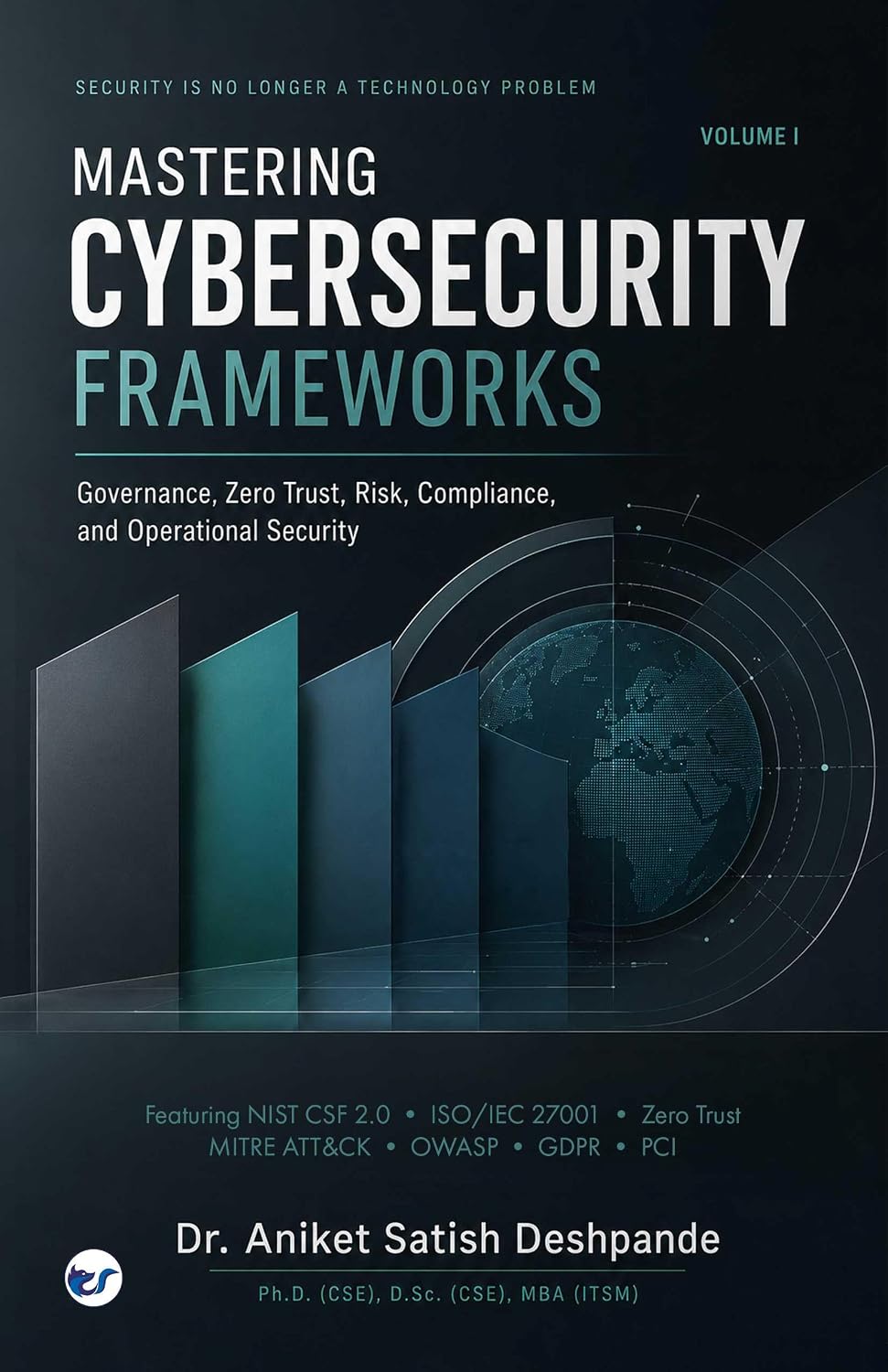
Mastering Cybersecurity Frameworks: Building the Architecture of Modern Digital Trust
A Comprehensive Exploration of Governance, Zero Trust, Risk, Compliance, and Operational Security
Book: Mastering Cybersecurity Frameworks: Volume I — Governance, Zero Trust, Risk, Compliance, and Operational Security
Author: Dr Aniket Deshpande
Cybersecurity Beyond Technology
Cybersecurity is often perceived as a battle between sophisticated technologies and increasingly sophisticated cyber attackers. Firewalls, encryption, endpoint protection, identity management, threat detection, and artificial intelligence have all become essential components of the modern security landscape. Yet, as organizations continue to experience major security incidents despite significant investments in technology, an important question emerges: Is technology alone enough to create a secure organization?
Dr Aniket Deshpande’s Mastering Cybersecurity Frameworks: Volume I approaches cybersecurity from a broader and more strategic perspective. The book argues that modern security failures are rarely the result of a single technological weakness. Instead, they frequently emerge from fragmented governance, unclear accountability, complex operational environments, excessive trust, cloud dependencies, inadequate risk management, and constantly changing adversarial behavior.
This perspective makes the book particularly relevant to organizations attempting to build cybersecurity programs that are not merely compliant, but genuinely resilient.
Understanding the Framework Landscape
One of the biggest challenges facing cybersecurity professionals today is the sheer number of frameworks, standards, controls, and security models available to organizations.
NIST CSF 2.0, ISO/IEC 27001, CIS Controls, COBIT, ITIL, OWASP, PCI DSS, MITRE ATT&CK, and Zero Trust Architecture each address different aspects of cybersecurity and enterprise risk. However, organizations can struggle when these frameworks are implemented independently, creating overlapping controls, fragmented processes, duplicated efforts, and uncertainty about priorities.
Mastering Cybersecurity Frameworks addresses this challenge by examining these frameworks in context. Instead of simply listing their requirements, the book explores the security, governance, and operational problems that each framework was created to solve.
This approach encourages readers to move beyond the question of “Which framework should we follow?” toward a more meaningful question: “How can these frameworks collectively help us build a stronger security ecosystem?”
From Compliance to Real Security
Compliance is an important component of cybersecurity, but compliance alone does not necessarily guarantee security.
An organization may successfully complete an audit and still possess vulnerabilities that could be exploited by attackers. This disconnect between documented controls and operational reality is one of the central challenges explored in the book.
Dr Deshpande emphasizes the importance of understanding the intent behind security controls. Rather than treating compliance requirements as boxes that need to be checked, organizations should understand how those requirements contribute to risk reduction, accountability, resilience, and business continuity.
This makes the book especially valuable for auditors, governance leaders, compliance professionals, and security consultants, who must frequently translate regulatory and framework requirements into practical organizational processes.
The Governance Dimension of Cybersecurity
Effective cybersecurity begins long before a security incident occurs. It starts with leadership, accountability, risk ownership, policies, decision-making structures, and clearly defined responsibilities.
The governance perspective of the book recognizes that security cannot remain confined to the IT department. Cybersecurity decisions increasingly affect business operations, finance, legal responsibilities, supply chains, customer relationships, and organizational reputation.
By placing governance at the heart of cybersecurity, the book highlights the importance of creating security programs where technical teams and business leaders share a common understanding of risk.
This is particularly important in large enterprises, where security decisions can become complicated by multiple business units, technology environments, vendors, regulatory requirements, and geographical locations.
Zero Trust in a Connected Enterprise
Perhaps one of the most important themes in modern cybersecurity is the shift away from traditional perimeter-based security.
Cloud computing, remote work, mobile devices, SaaS platforms, APIs, third-party integrations, and distributed applications have made the concept of a clearly defined organizational perimeter increasingly difficult to maintain.
The book’s discussion of Zero Trust Architecture is therefore highly relevant. Zero Trust challenges the assumption that users, devices, applications, or networks should automatically be trusted simply because they exist within a particular environment.
Instead, security must be based on continuous verification, appropriate access, identity, context, and risk.
By discussing Zero Trust within the wider framework landscape, the book presents it not merely as a technology trend but as part of a broader transformation in how organizations approach digital trust.
Making Sense of Risk
Risk management is another major pillar of the book.
Every organization faces cyber risk, but not every risk can be eliminated. Organizations must therefore identify, assess, prioritize, mitigate, monitor, and communicate risk in ways that align with business objectives.
This requires more than technical vulnerability assessments. It requires an understanding of business impact, critical assets, dependencies, threat actors, operational processes, and organizational tolerance for risk.
The book helps position cybersecurity risk within this broader enterprise context, making it relevant to professionals who must communicate security concerns to senior management and decision-makers.
Connecting Strategy With Operations
A strong cybersecurity strategy can fail if it cannot be effectively implemented.
This gap between strategy and operations is a recurring challenge across organizations. Policies may exist, frameworks may be adopted, and controls may be documented, but their effectiveness ultimately depends on how consistently they are implemented and monitored.
The book’s emphasis on operational security helps bridge this divide. It encourages readers to consider how security frameworks translate into everyday processes, responsibilities, technical controls, monitoring activities, incident response, and continuous improvement.
This practical orientation is one of the book’s strengths because it recognizes that cybersecurity maturity is built through sustained operational discipline rather than through one-time implementation exercises.
NIST CSF 2.0 and a Modern Security Approach
The inclusion of NIST Cybersecurity Framework 2.0 gives the book a strong contemporary foundation.
NIST CSF provides organizations with a structured way to think about cybersecurity outcomes and risk management. Within the book’s broader framework discussion, it becomes part of a larger conversation about how organizations can organize security activities and communicate cybersecurity priorities.
Rather than treating NIST as a standalone solution, the book explores its relevance alongside other frameworks, allowing readers to understand where different models overlap and where they serve distinct purposes.
ISO/IEC 27001 and Information Security Management
For organizations focused on establishing formal information security management systems, ISO/IEC 27001 remains an important reference point.
The book places information security management within the broader governance and risk landscape, helping readers understand why an effective management system requires more than technical controls.
Policies, risk assessment, organizational responsibilities, continual improvement, documentation, and leadership commitment all contribute to the effectiveness of an information security management system.
This discussion can be particularly useful for organizations seeking to connect certification and compliance initiatives with meaningful improvements in their security posture.
CIS Controls and Practical Security Priorities
While governance frameworks can provide strategic direction, organizations also need practical controls that address common security risks.
The CIS Controls offer a prioritized approach to improving cybersecurity defenses. Their inclusion in the book adds an important operational dimension to the discussion.
For security teams attempting to determine where to focus limited resources, understanding prioritized controls can help establish a foundation for security improvement.
The book’s broader framework-oriented approach also encourages readers to see such controls as components of a larger security strategy rather than isolated technical measures.
COBIT and IT Governance
Cybersecurity does not exist independently from IT governance.
The inclusion of COBIT and ITIL demonstrates the book’s recognition that security must operate within the wider ecosystem of technology management, governance, service delivery, and organizational processes.
COBIT brings governance and management considerations into the conversation, while ITIL provides perspectives related to IT service management.
Together, they help illustrate how cybersecurity intersects with the processes organizations already use to manage technology and deliver services.
OWASP and Application Security
As applications become central to almost every digital business, application security has become a critical part of enterprise cybersecurity.
The book’s coverage of OWASP brings attention to the risks associated with software applications and development practices.
Modern security programs cannot focus exclusively on networks and infrastructure. Vulnerabilities can emerge through application design, coding practices, authentication mechanisms, APIs, configuration, and software dependencies.
By including application security alongside governance and enterprise frameworks, the book reinforces the interconnected nature of modern cybersecurity.
PCI DSS and the Importance of Industry-Specific Security
Not all cybersecurity requirements are universal. Certain industries and business models operate under specific regulatory and security expectations.
The inclusion of PCI DSS demonstrates how security frameworks can address specialized requirements, particularly in environments involving payment card data.
This provides readers with a useful reminder that cybersecurity programs often need to accommodate multiple layers of requirements simultaneously.
MITRE ATT&CK and the Adversarial Perspective
A cybersecurity framework cannot be fully understood without considering the behavior of attackers.
The book’s treatment of MITRE ATT&CK introduces an adversary-focused perspective, helping organizations think beyond static controls and consider how attackers operate, what techniques they employ, and how defensive capabilities can be aligned against real-world behaviors.
This perspective is valuable because effective cybersecurity requires organizations to continuously adapt to changing threats.
The Challenge of Cloud and Digital Transformation
Cloud adoption has transformed the enterprise technology environment. Applications, infrastructure, data, identities, and services can now exist across multiple platforms and providers.
While cloud technologies offer flexibility and scalability, they also introduce new security considerations and complex trust relationships.
The book’s broader discussion of cloud dependency and operational complexity reflects this reality. Security teams must understand that digital transformation can change not only technology architecture but also the organization’s risk profile and governance requirements.
Designed for Cybersecurity Professionals and Decision-Makers
One of the book’s notable strengths is the breadth of its intended audience.
It speaks to cybersecurity practitioners, architects, governance leaders, auditors, consultants, and enterprise decision-makers. This broad audience reflects the multidisciplinary nature of cybersecurity itself.
Technical professionals can gain a broader understanding of governance and risk, while business leaders can better appreciate the architectural and operational realities behind cybersecurity decisions.
For consultants and auditors, the book can also provide a useful framework for understanding how multiple standards and models can be interpreted within an enterprise environment.
Bridging the Gap Between Theory and Practice
Perhaps the strongest contribution of Mastering Cybersecurity Frameworks: Volume I is its attempt to bridge two worlds that are often treated separately: cybersecurity theory and operational reality.
Frameworks provide structure. Technology provides capabilities. Governance provides accountability. Risk management provides prioritization. Operations provide execution.
None of these elements can deliver effective security in isolation.
The book encourages readers to consider cybersecurity as an integrated system in which these components continuously interact.
A Timely Resource for a Changing Threat Landscape
Cybersecurity is not static. Threat actors evolve, technologies change, regulations develop, and organizations continually adopt new digital platforms.
In such an environment, professionals need more than knowledge of individual frameworks. They need the ability to understand how different security principles can be combined and adapted to changing circumstances.
This is where Dr Aniket Deshpande’s book finds its relevance. Rather than presenting cybersecurity frameworks as rigid structures, it encourages readers to understand their purpose, relationships, and practical application.
Final Verdict
Mastering Cybersecurity Frameworks: Volume I – Governance, Zero Trust, Risk, Compliance, and Operational Security is a substantial contribution to the growing body of practical cybersecurity literature.
Its greatest strength lies in its integrated perspective. Instead of reducing cybersecurity to technology or compliance, the book examines the wider ecosystem of governance, risk, architecture, operations, application security, adversarial behavior, and digital trust.
For cybersecurity professionals, it offers a structured way to connect multiple frameworks. For governance and compliance leaders, it provides context for moving beyond checklist-driven security. For enterprise decision-makers, it highlights why cybersecurity must be treated as a strategic organizational responsibility.
In an increasingly interconnected digital world, organizations cannot afford to view cybersecurity as a collection of isolated controls. They need a coherent understanding of how governance, risk, technology, people, and processes work together.
That is the central value of Mastering Cybersecurity Frameworks: Volume I: it invites readers to move from simply knowing cybersecurity frameworks to understanding how those frameworks can contribute to meaningful, resilient, and operationally effective security.