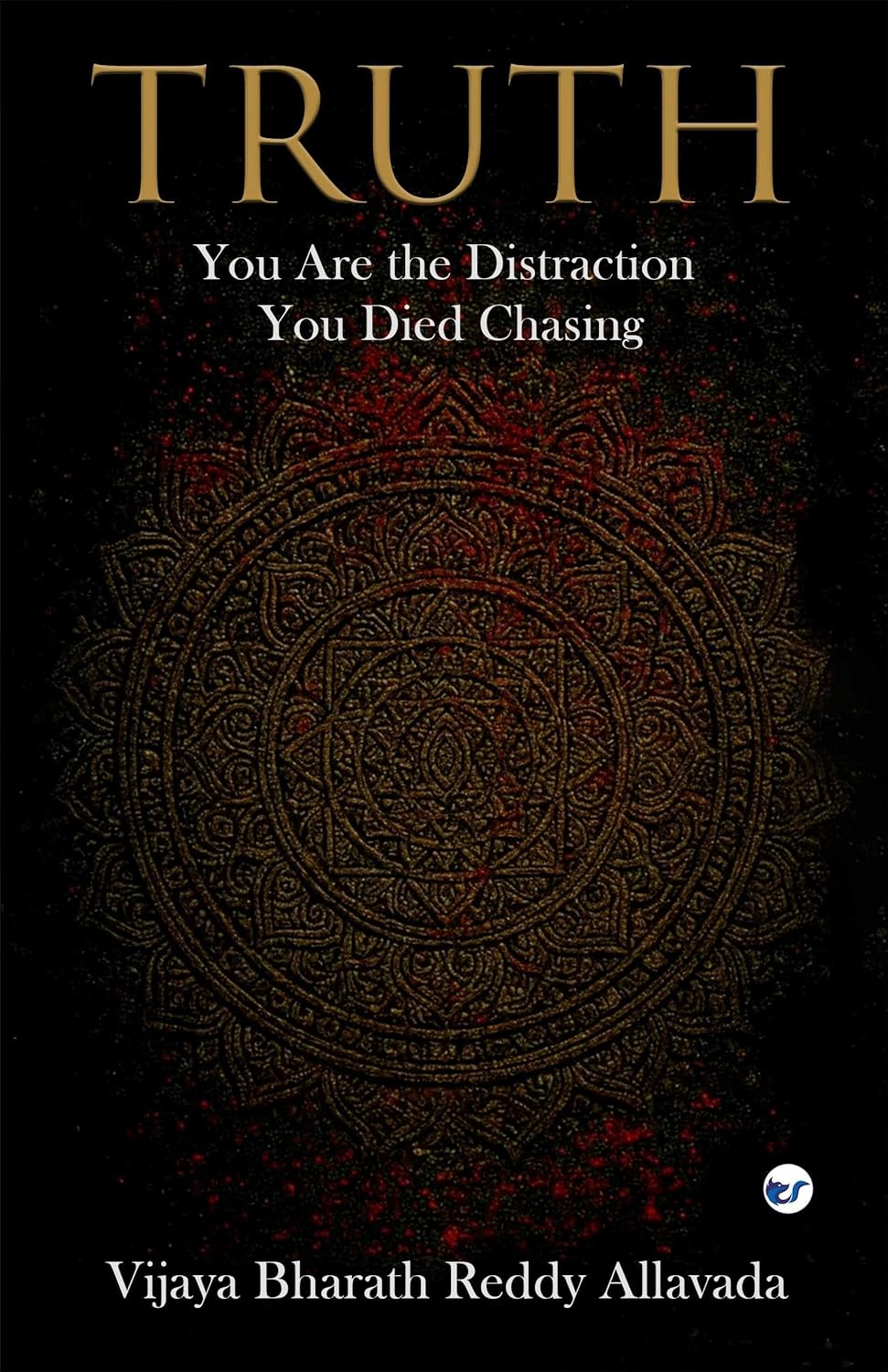
A Journey Beyond the Self: A Reflective Review of Truth: You Are the Distraction You Died Chasing by Vijaya Bharath Reddy Allavada
In a literary landscape often dominated by self-help formulas and prescriptive philosophies, Truth: You Are the Distraction You Died Chasing by Vijaya Bharath Reddy Allavada stands apart as a deeply introspective and unconventional work. Rather than offering answers, this book gently dismantles the very need for them, inviting readers into a space of inquiry that is both unsettling and profoundly transformative.
At its core, this is not a book to be “read” in the traditional sense-it is a book to be experienced. Blending poetic expression with philosophical depth, the author crafts a narrative that acts less like a guide and more like a mirror. It reflects the reader’s inner landscape, challenging long-held assumptions about identity, purpose, and the nature of reality itself.
A Philosophical Exploration Rooted in Indian Wisdom
Drawing inspiration from the timeless teachings of the Upanishads and the epic Mahābhārata, the book is firmly grounded in the traditions of Advaita Vedanta. However, it does not overwhelm the reader with heavy terminology or rigid doctrine. Instead, it distills these ancient insights into a contemporary, accessible voice that resonates with modern seekers.
The text moves fluidly through the states of waking, dreaming, and deep sleep-concepts central to Indian philosophy-before pointing toward Turiya, the “fourth” state of pure awareness. This progression is not presented as a linear path to be followed, but as an invitation to observe and question the layers of one’s own experience.
What makes this exploration compelling is its subtlety. Rather than asserting truths, the author poses questions-questions that linger long after the page is turned. Who is the one seeking? Who is the doer behind every action? And what remains when all labels and narratives dissolve?
Poetry Meets Philosophy
One of the book’s most striking features is its language. There is a lyrical quality to the writing that elevates it beyond conventional philosophical discourse. The prose often feels like poetry-measured, reflective, and deeply evocative.
This stylistic choice serves an important purpose. The subject matter itself-consciousness, identity, and the illusion of self-resists straightforward explanation. By embracing a poetic tone, the author allows meaning to emerge intuitively rather than intellectually. Readers are encouraged not just to understand the words, but to feel them.
At times, the writing can feel deliberately elusive. Yet this is not a flaw; it is a reflection of the book’s central theme. Just as the self cannot be pinned down by definitions, the text resists being reduced to simple interpretations. It invites patience, presence, and a willingness to sit with ambiguity.
Challenging the Seeker
Unlike many spiritual books that position the reader as a seeker on a journey toward enlightenment, Truth takes a radically different approach. It questions the very identity of the seeker itself.
The idea that “you are the distraction you died chasing” is both provocative and disorienting. It suggests that the search for truth may itself be the barrier to realizing it. This perspective can feel uncomfortable, even confronting, particularly for readers accustomed to structured paths and clear outcomes.
Yet it is precisely this discomfort that gives the book its power. By stripping away familiar frameworks, the author creates space for a deeper, more authentic form of understanding-one that arises not from accumulation, but from letting go.
A Book That Lingers Beyond the Page
Perhaps the most remarkable aspect of this work is its aftereffect. Long after finishing the book, its questions continue to echo in the reader’s mind. It is not a book that provides closure; rather, it opens a doorway to ongoing reflection.
This makes it particularly suited for readers who are already inclined toward introspection, mindfulness, or non-dual philosophy. Those seeking quick answers or practical techniques may find it challenging. But for those willing to engage with its depth, the rewards are significant.
Final Verdict
Truth: You Are the Distraction You Died Chasing is a bold and thought-provoking debut that defies categorization. It is at once philosophical, poetic, and deeply personal-an exploration of consciousness that refuses to be confined by conventional boundaries.
Vijaya Bharath Reddy Allavada has crafted a work that does not simply inform, but transforms. It invites readers to pause, reflect, and ultimately question the very foundation of their perception.
In a world filled with noise, this book offers something rare: a return to stillness. And in that stillness, perhaps, lies the truth it so quietly points toward.