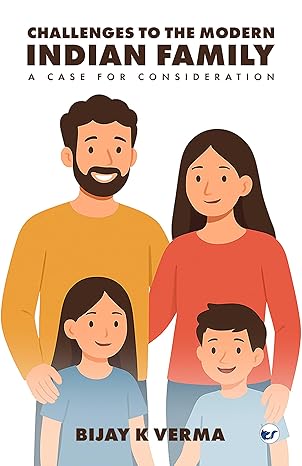
In Challenges To The Modern Indian Family: A Case For Consideration, Dr. Bijay Kumar Verma presents a timely and thought-provoking examination of one of the most significant social transformations unfolding in contemporary India—the changing nature of the family. Rooted in sociological insight and cultural reflection, the book argues persuasively that the family, long regarded as the foundation of Indian society, is facing unprecedented challenges in the age of modernity.
At the heart of the book lies a powerful premise: the family precedes the individual and remains inseparable from human life, liberty, and happiness. Dr. Verma situates this idea against the backdrop of rising individualism, rapid urbanization, economic mobility, and evolving cultural values, all of which are reshaping how younger generations perceive marriage, kinship, and family responsibilities.
Examining the Shift in Youth Attitudes
One of the book’s most compelling contributions is its focus on the attitudes of educated, high-income youth, particularly in urban and semi-urban India. Historically, young people have played a central role in forming and sustaining families. Today, however, many increasingly question the relevance of traditional family structures, prioritizing personal freedom, career ambitions, and alternative lifestyles over marriage and long-term familial commitments.
Dr. Verma does not dismiss these choices outright. Instead, he carefully examines the motivations behind them, acknowledging the pressures of modern life while raising critical questions about their long-term social, emotional, and cultural consequences. The book Challenges To The Modern Indian Family invites readers to reflect on whether the pursuit of individual fulfillment, when detached from family bonds, can truly lead to lasting well-being.
The Indian Context and Regional Focus
A notable strength of the book Challenges To The Modern Indian Family is its grounding in the Indian socio-cultural context, with particular attention to the state of Bihar. By anchoring the discussion in a specific region, Dr. Verma provides a nuanced understanding of how modernization interacts with deeply rooted traditions. This regional focus allows the reader to see how global trends—such as urban migration and changing gender roles—manifest differently across social and economic landscapes within India.
Rather than presenting nostalgia for the past, the author offers a realistic assessment of the tensions between tradition and change, making the book especially relevant for sociologists, policymakers, educators, and social workers.
Preserving Family Bonds in a Modern Society
Beyond diagnosis, Challenges To The Modern Indian Family also seeks pathways forward. Dr. Verma explores ways in which the essence of familial bonds—mutual care, interdependence, and emotional security—can be preserved without denying the realities of a rapidly modernizing society. His analysis suggests that the survival of the family does not depend on resisting change, but on reinterpreting family values in ways that remain meaningful to younger generations.
The book Challenges To The Modern Indian Family encourages dialogue rather than prescription, urging readers to consider how families, institutions, and communities can adapt while retaining their core human functions.
Writing Style and Approach
Written in a clear, accessible, and reflective style, the book balances academic seriousness with readability. Dr. Verma’s arguments are grounded in observation and social reasoning, making the work suitable not only for scholars but also for general readers concerned about the future of Indian society.
Conclusion
Challenges To The Modern Indian Family: A Case For Consideration is a thoughtful and necessary contribution to discussions on family, culture, and social change in India. By critically examining the forces reshaping family life and highlighting the implications of shifting youth attitudes, Dr. Bijay Kumar Verma offers readers an opportunity to reflect on what may be gained—and what risks being lost—in the march toward modernity.
This book Challenges To The Modern Indian Family is recommended for readers interested in Indian society, family studies, sociology, cultural change, and youth perspectives, as well as anyone concerned with the evolving balance between individual aspirations and collective well-being.