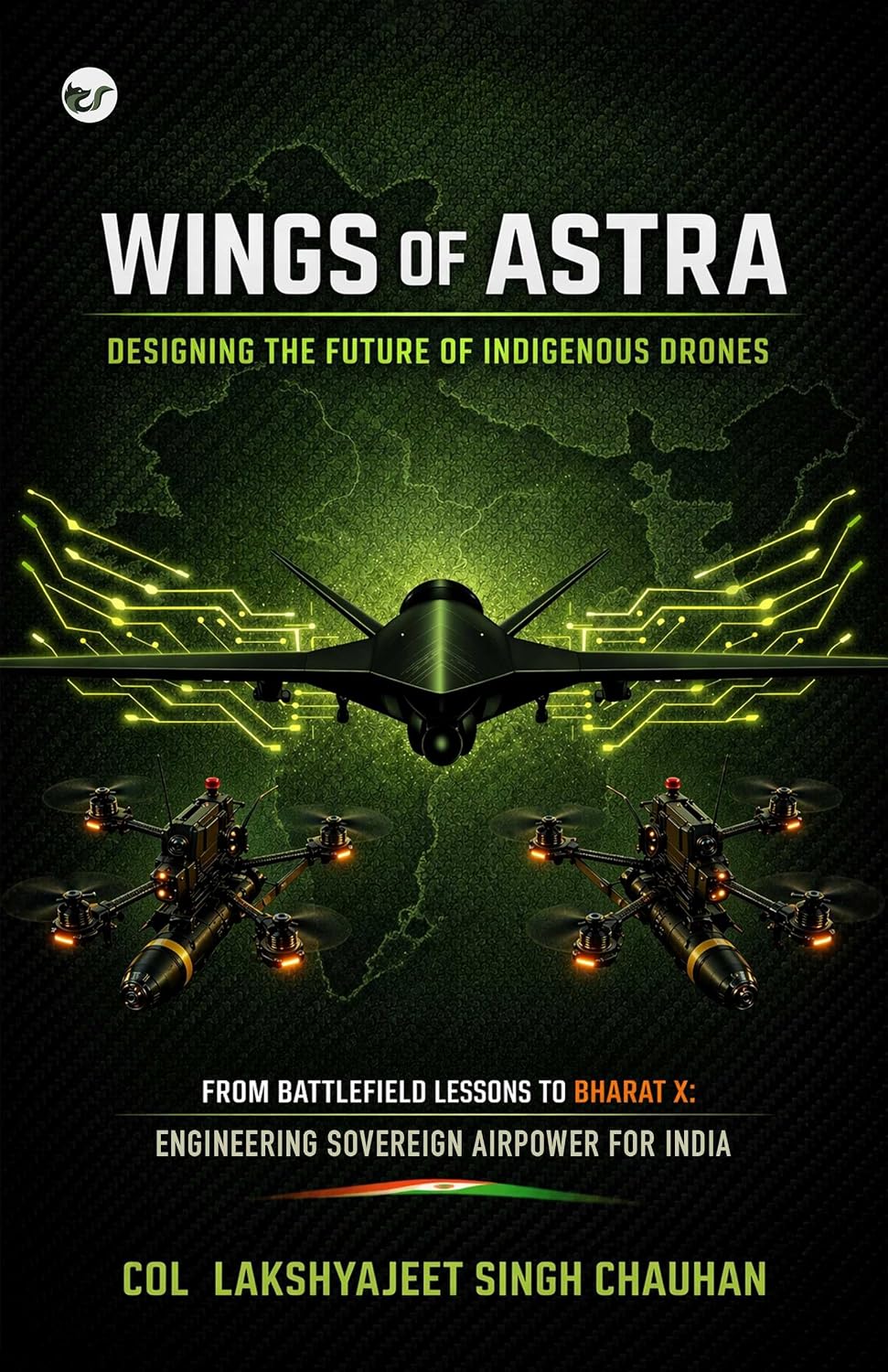
Technology is increasingly becoming a decisive factor in shaping the future of nations, and few technologies illustrate this transformation as clearly as unmanned aerial vehicles, or drones. Wings of Astra: India’s Rise in Indigenous Drone Technology by Col. Lakshyajeet Singh Chauhan is a compelling and ambitious exploration of India’s journey toward becoming a leader in indigenous drone technology.
Rather than presenting drones merely as futuristic machines or instruments of modern warfare, the book examines them as complex systems that can influence national security, agriculture, healthcare, disaster management, manufacturing, and economic development. It brings together military experience, engineering principles, research, entrepreneurship, and policymaking to create a comprehensive perspective on India’s emerging drone ecosystem.
A New Revolution in the Skies
The book begins with a powerful premise: the world is entering a new technological revolution, and unmanned systems are at its center. Drones are no longer limited to surveillance or military applications. They are rapidly becoming tools capable of transforming how nations protect their borders, deliver essential services, manage agriculture, respond to disasters, and build industrial capabilities.
Col. Chauhan captures this transformation effectively by placing India’s drone ambitions within a larger technological and strategic context. The book encourages readers to look beyond the excitement surrounding drones and focus on the deeper question of technological independence.
For India, the challenge is not simply to purchase sophisticated drones but to develop the ability to design, manufacture, maintain, and continuously improve the technologies that make these systems possible.
From Battlefield Experience to Engineering Insight
One of the book’s strongest features is the author’s unique perspective. Drawing upon military leadership, aerospace research, UAV development, and exposure to India’s growing startup ecosystem, Col. Chauhan approaches the subject from both operational and engineering viewpoints.
This combination gives the book practical depth. Instead of discussing drones only as abstract technological concepts, the author examines the realities involved in converting operational requirements into functional engineering solutions.
The gap between what soldiers need, what policymakers envision, and what engineers can realistically develop is an important challenge. Wings of Astra attempts to address precisely this gap, offering readers a structured way of thinking about UAV development.
The Innovative “Living Machine” Framework
One of the most memorable concepts introduced in the book is the “Living Machine” framework. By comparing a drone to a living organism, the author makes complicated UAV architecture easier to understand.
The airframe becomes the skeleton, propulsion functions as the muscles, the flight controller acts as the brain, and the communication system functions like the nervous system. This analogy provides an intuitive framework for understanding how different components must work together as one integrated system.
The strength of this approach is its simplicity. Instead of treating individual components as isolated technologies, the framework encourages designers to consider the entire system and its mission requirements.
For students, engineers, entrepreneurs, and professionals entering the UAV industry, this systems-thinking approach can be particularly valuable.
Indigenisation as a Strategic Necessity
A central theme throughout the book is technological sovereignty. The author makes a strong case that true national capability cannot depend entirely on imported platforms and critical components.
Indigenous development involves much more than assembling drones domestically. It requires expertise in areas such as airframes, propulsion, electronics, flight control, communication systems, sensors, software, and manufacturing.
The book therefore presents indigenisation not simply as an economic objective but as a strategic necessity. Developing these capabilities can strengthen national resilience while simultaneously creating opportunities for innovation, entrepreneurship, research, and employment.
Beyond Defence Applications
Although national security forms an important part of the discussion, the book’s vision extends far beyond military applications.
Drones can support precision agriculture, deliver medical supplies to remote locations, assist disaster-response teams, monitor infrastructure, improve industrial operations, and contribute to a wide range of civilian applications.
This broader perspective makes the book particularly relevant to entrepreneurs and policymakers. It demonstrates that India’s drone revolution can potentially become an important part of the country’s wider technological and economic transformation.
The same technological capabilities developed for demanding defence applications can often generate solutions for civilian challenges.
Connecting Soldiers, Engineers, Policymakers, and Entrepreneurs
Another major strength of Wings of Astra is its emphasis on collaboration. Building a successful indigenous drone ecosystem requires more than brilliant engineering. It requires communication between military users, researchers, manufacturers, startups, investors, regulators, and policymakers.
The book highlights the importance of connecting these different stakeholders so that operational requirements can be translated into practical engineering solutions and eventually scalable products.
This makes the work particularly relevant at a time when India’s startup ecosystem and government initiatives are increasingly encouraging indigenous technology development.
A Practical and Visionary Approach
The book successfully balances vision with practical thinking. It does not simply celebrate the possibilities of drone technology; it encourages readers to consider the engineering discipline required to turn those possibilities into reality.
Its emphasis on mission definition, system integration, design choices, scalability, and manufacturing demonstrates that technological leadership is built through consistent engineering decisions rather than grand declarations.
The writing also carries a strong sense of national purpose, making the book particularly inspiring for readers interested in India’s technological future.
Final Verdict
Wings of Astra: India’s Rise in Indigenous Drone Technology is a thought-provoking and timely exploration of India’s emerging capabilities in unmanned aerial systems. Col. Lakshyajeet Singh Chauhan combines operational experience, engineering knowledge, and strategic thinking to present a compelling vision for an indigenous drone ecosystem.
The book’s greatest contribution is its insistence that drones should be understood not merely as machines but as integrated technological systems requiring disciplined design, collaboration, innovation, and long-term investment.