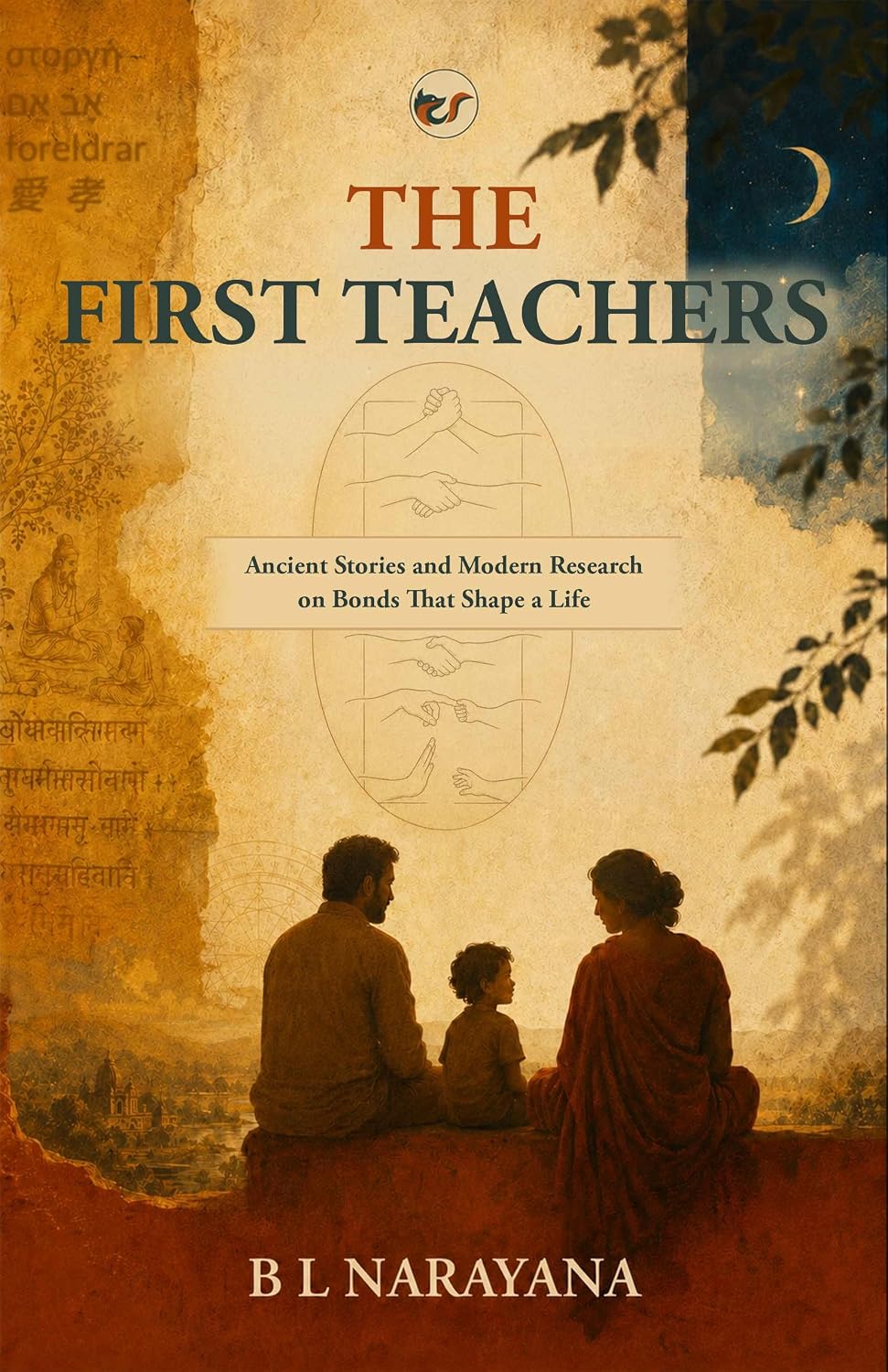
The First Teachers: Ancient Stories and Modern Research on Bonds That Shape a Life
By B L Narayana
Some books on parenting offer rules. Others on mythology invite us to look backward at stories that have survived generations. The First Teachers: Ancient Stories and Modern Research on Bonds That Shape a Life by B L Narayana takes a more contemplative path. Rather than telling readers what to think or how to parent, the book invites them to observe one of the most fundamental relationships in human life-the bond between parent and child.
At the heart of the book is a fascinating meeting point between ancient storytelling and modern scientific research. Stories drawn from the Sanskrit epics, the Upanishads, Homer, Norse traditions, and Hebrew scriptures are placed alongside insights from attachment theory, developmental psychology, and neuroscience. The result is not an attempt to prove that ancient stories anticipated modern science, but an exploration of how different traditions have long grappled with questions that remain deeply relevant today.
When Ancient Stories Meet Modern Research
One of the book’s most interesting strengths is its approach to comparison. Narayana does not force mythology and science into the same framework. Instead, the stories and research are allowed to stand independently while illuminating similar aspects of human experience.
This makes the book particularly engaging for readers who enjoy exploring the intersection of mythology, psychology, parenting, human relationships, and neuroscience. A story from an ancient tradition can evoke questions about attachment, emotional dependence, parental expectations, identity, or childhood development-questions that modern researchers continue to investigate using very different methods.
The contrast between these two approaches adds depth to the reading experience. Ancient stories speak through metaphor, memory, conflict, and character, while modern research provides empirical frameworks for understanding human development.
Ten Patterns, Ten Windows Into Parenthood
The book is structured around ten recurring patterns in parent-child relationships. Each chapter examines a particular dynamic that can emerge between parents and children, creating a series of reflections on how early relationships influence the people we eventually become.
Among the themes explored is the parent whose love becomes blinding, raising questions about when affection can become protection, possession, or an inability to see a child clearly. Another pattern considers the child whose abilities or ambitions extend beyond the boundaries of the family environment.
There is also the powerful theme of the truth a mother carries, suggesting that parenthood is not simply about guidance and authority but also about memory, responsibility, silence, sacrifice, and difficult truths.
These patterns give the book a strong emotional dimension. They are not merely abstract psychological concepts; they are experiences many readers may recognize from their own families.
Parenting Through the Lens of Being a Child
Perhaps the most compelling aspect of The First Teachers is that it does not treat parenting as an isolated stage of adulthood. Every parent was once a child.
That simple observation creates an important layer of introspection. Our understanding of parenting is inevitably influenced by our own experiences of being parented—the affection we received, the expectations placed upon us, the things that were said, and perhaps even the things that were never spoken.
For readers who are parents, this perspective can encourage meaningful self-reflection. For readers who are not parents, the book remains relevant because its subject is not limited to raising children. It is also about how relationships shape identity and how childhood experiences continue to echo through adult life.
A Thoughtful Exploration Rather Than a Parenting Manual
The book’s refusal to become a conventional parenting guide is one of its defining qualities. It does not present a rigid formula for raising children. Instead, it asks readers to notice patterns and consider their implications.
This observational approach makes the book feel less prescriptive and more philosophical. Readers are encouraged to draw connections for themselves, rather than being handed predetermined conclusions.
That quality may appeal especially to those who prefer books that leave room for reflection and discussion. The stories become starting points for questions rather than simple lessons.
Why the Book Matters Today
Modern parenting exists in a world filled with advice, research, social expectations, and competing ideas about what children need. In such an environment, The First Teachers offers a broader perspective by reminding readers that questions surrounding family, attachment, sacrifice, ambition, protection, and identity are hardly new.
Civilizations separated by centuries and geography have repeatedly told stories about parents and children facing complicated emotional choices. Modern psychology approaches these questions through observation and research. By bringing these perspectives into conversation, Narayana creates an opportunity to consider how much has changed-and how much has remained remarkably consistent.
Final Verdict
The First Teachers is a reflective and intellectually engaging exploration of one of life’s most influential relationships. B L Narayana brings together mythology, psychology, developmental science, and neuroscience without reducing one discipline to another.
Its greatest strength lies in its invitation to observe rather than prescribe. The ancient stories provide emotional and cultural depth, while modern research offers another lens through which readers can examine familiar patterns.
For parents, it can become an opportunity for self-reflection. For readers interested in mythology and psychology, it offers an unusual interdisciplinary journey. And for anyone who has ever wondered how childhood continues to shape adulthood, the book presents plenty of material to contemplate.
Ultimately, The First Teachers reminds us that our earliest relationships may be among our most enduring teachers-and that understanding them may require looking simultaneously into the stories of the past and the discoveries of the present.